Note: I almost didn’t do this post, figuring pretty much everybody already knows everything about Mars already, right? But I ended up doing it because a) I’ve been following Mars* across the sky for months now and b) the stuff about Mars’ moons turned out to be way freaky cool.
*Speaking of following Mars… Though these Astro-posts may seem a bit random, I’m actually going somewhere with it. My goal is to continue East across the Southern sky, filling in blanks, until I make a complete “wrap-around.” Then someone who’s been following this blog would have a complete map across the sky, with a bunch of neat stories about stars and such along the way. Wouldn’t that be cool? Anyway, that’s the idea- we’ll see where it goes. Got my eye on Hydra and Saturn next…
I usually camp down in the desert a handful of times over the winter, but this past season only did so once, back in January with Arizona Steve. As is my habit I slept out under the stars, and as I often do when camping, woke briefly every few hours, and glanced quickly at the sky each time. My feet were pointed West, and gradually, next to Gemini, a bright orange star tread its way across the sky, setting by the foot of my sleeping bag around 4:30. As we know by now, there are many orange stars in the sky- Betelgeuse, Aldebaran, Pollux- but Mars is brighter than them all.

*It can be 1st, 2nd or 3rd depending on where it, Venus and Mercury are in their orbits relative to Earth.
**Usually Jupiter is brighter.

What I love most about Mars is that it’s the only thing you can look up at which has- like Earth- both ground and sky.
Mars And My Family
My father was* an electrical engineer. He worked for 4 companies in his entire career, a number I beat by age 30. In the mid-1970’s he worked for Itek Optical Systems Division, a subsidiary of Litton Industries, the company that developed and produced the cameras for the Viking Lander program. After the successful completion of the mission, my father and the rest of his team received as a gift a bound coffee-table book full of color photos of the Martian landscape and sky. Today this doesn’t sound like a big deal, but in 1977, to a sci-fi-obsessed 13 year old kid, before Internet or (in our house at least) color TV, it was amazing. One day my dad just brought home a picture book from another planet. I’d seen pictures from the Moon of course, but Mars was way different. The surface was that striking orange, compared to the endless gray of the lunar surface, but the big difference was sky. It wasn’t just a rock in space- the place had sky. It may have been the wrong color, but it was really sky.
*The past tense in this instance indicates his career, not his life. My dad is alive, healthy and happily retired.

*I once read (forget the source) that Venus’ atmosphere is so dense that if it were clear, light at the surface would be bents such that you could see clear around the planet in the sky above.

Extra Detail: Interestingly, it appears that Mars had a magnetic field in the distant past and that, like our magnetic field, it periodically reversed polarity. Scientists theorize that a few billion years back Mars’ outer core cooled and solidified enough to shut down the convection currents producing the field.
When I first saw color photos of the Martian surface, I was reminded of the American Southwest, which I’d only seen in photos at the time, and when I eventually made to places like Moab- but before I knew much about Mars- I wondered if I was seeing something like Mars, but the resemblance is purely coincidental.* The orange of the Martian surface isn’t the orange of (sedimentary) slickrock, but rather the orange of rust- ferrous oxide (FeO).

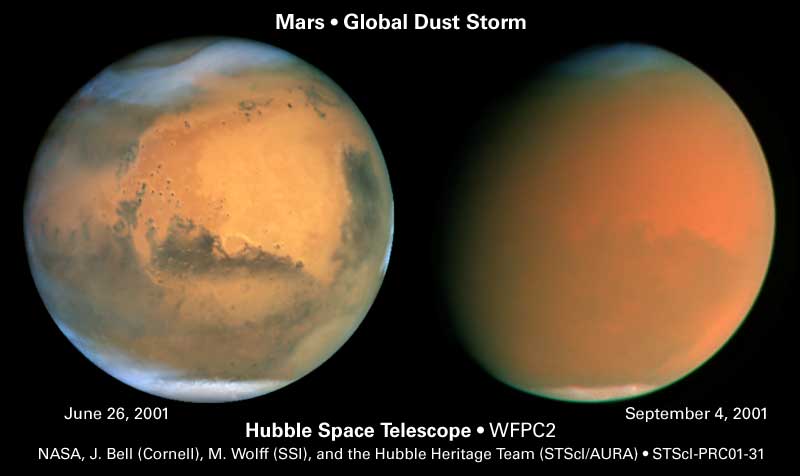
The ferrous oxide dusts in the atmosphere give the Martian sky its strange and lovely orange/pink hue, making for spectacular sunsets. Mars has sunsets and sunrises about as often as we do; the Martian day is 24 hours and 40 minutes long. Mars also has seasons; its axis is tilted 25 degrees, compared with 23.5 degrees for Earth. Of course the seasons are each about twice as long as ours, as the Martian year is about 687 (Earth) days long.
Mars has polar ice caps (pic left) up to 2 miles thick, and over the long seasons these caps grow and recede annually. 
*It’s still unresolved as to whether liquid water ever flows on the Martian surface nowadays, though there have been tantalizing hints in recent years.
** Sublimate = convert from solid to gas, with no intermediate liquid phase.

Side Note: Although the winds in such storms can reach speeds of a couple hundred miles per hour, they don’t pack the punch of Earth-winds at that speed, due to the low density of the Martian atmosphere.
Speaking of ice, Mars has clouds. Not the wet, cumulus-style clouds I blogged about up in Montana, but cirrus clouds, like we get here way up high in the stratosphere on Earth and are composed not of water droplets, but of ice crystals. But on Mars, there are 2 types of cirrus clouds: H2O and CO2, with CO2 clouds typically occurring at higher (and colder) altitudes.
Mars is superlative in other ways. It boasts a canyon, Valles Marineris, that is 2,500 miles long and 4 miles deep- 9 times as long and 4 times as deep as the Grand Canyon- and which was apparently formed by ancient water flows. Mars’ highest peak- Olympus Mons- is an extinct volcano 3 times the height of Everest. If such a peak stood on Earth, it would tower far into the stratosphere, higher than any jetliner could fly.
But when I look at Mars at night, I’m most fascinated by what an observer there would see looking back. With air so thin, the night sky must be fantastic. Under ideal conditions far from cities, a human observer can see some 2,000* stars on a clear night. How many could one see from Mars? 10,000? 50,000? And which “star” would be the brightest?
*At one time. About 6,000 are visible total.
All About Phobos
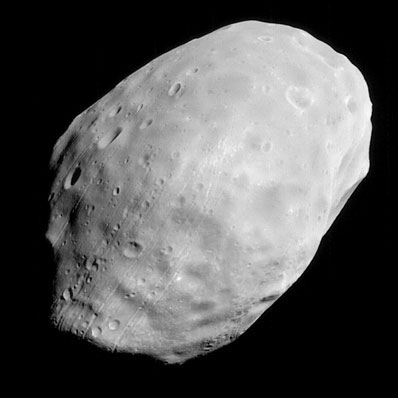
This one’s a little tricky, because probably the brightest “star” would the smaller of its 2 moons. Mars has 2 moons, Deimos and Phobos. Both are far smaller than our moon, and irregularly shaped. Phobos, the larger, is only 17 miles in diameter at its widest point. Our own, freakishly-large, moon is more than 2,000 miles in diameter! But Phobos appears fairly large in the Martian sky- about 1/3 the size of our own moon- because- and this is the coolest thing about Phobos- it orbits only ~3700 miles above the planet’s surface (compared with ~238,000 miles for our own moon.) This closeness has 3 weird effects. The first is that to a Martian observer, a “Phobean month” is only 11 hours long. And weirder still, Phobos rises in the West, and sets in the East.

*Pretty much everything in the solar system rotates and orbits in the same direction- counterclockwise, when viewed from above the Earth’s North Pole. There are exceptions, where things rotate or orbit clockwise, and these exceptions are called retrograde. Venus and Uranus, for example, have retrograde (and really weird- though for different reasons) rotations, as does Pluto. Similarly, some number of moons of the outer planets have retrograde orbits. Most of these are really small moons, and are thought to have been asteroids captured by the gravitationals field of the planets which they now orbit. But Neptune’s retrograde moon Triton is pretty respectable-sized- a large marble compared to the ping-pong ball of our moon.
Keep in mind that a retrograde moon might still appear to move East to West across the sky, depending on its orbital radius and speed, and the host-planet’s rotational speed. But that’s all beside the point. Neither of Mars’ moons is retrograde (though both are suspected to be captured asteroids); Phobos is just really low/close.

Side Note: There’s a fourth weird thing about Phobos, which while not directly related to its close-ness, is evident to a Mars-based observer because of it- its shape. It’s not spherical, but rather sorta-kinda elliptical/potato-shaped. So it looks like this giant tumbling potato going the wrong way across the sky.
Deimos is also sorta-kinda elliptical/potato-shaped, but is far/small enough that it wouldn’t be obvious to a naked-eye Mars-based observer.
A Bit About Deimos

So the brightest “star” in the Martian sky is a weird Venus-like thing that travels clear across the sky in just 3 days. But the 2nd brightest star is Earth. Earth is an inferior* planet to Mars, so it only appears in the Eastern or Western skies, near dawn or dusk. It’s a bright bluish star, but often appears white because of the reddish tint of the Martian sky. Our moon is also visible, as a smaller white star close by. Both present phases to Mars as inferior bodies- such as Mercury, Venus, and the (less-than-full) Moon- do to us, and the phases of both are always the same relative to a Martian observer.
*”Inferior” in astronomy means closer to the sun. “Superior” denotes further from the sun.

Of course anywhere on Earth, stuff is happening; birds pass by, bugs crawl past, flies buss, lichens grow. But when you look up at Mars, you’re looking at a world- a real world- with ground and sky and moons and sun and stars, where, really, nothing ever happens, and hasn’t happened for billions or years, if ever. Not just a mountaintop, but a whole planet. Just rocks, sand, ice and wind, an endless succession of days and nights for longer than you can ever imagine. It just boggles my mind.
Anyway, that’s what you’re seeing when you look up at that bright orange star East of Gemini.


![Lichen Genera Antelope[4]](https://blogger.googleusercontent.com/img/b/R29vZ2xl/AVvXsEhcyeqB4DIiA1uWZPg83I4lR1pxcJ5O8BO2m3M17lFoIP-0gbzPyQczvT8g3WiMaKmuKmxFWHSBiJckZC926ayhfYyQ4VFiX4OTQxarMgDGlU4eyBIfQT6YlrF3Z8Gb0TuK9RcUntLZScY/?imgmax=800 "Lichen Genera Antelope[4]")