Showing posts with label creosote. Show all posts

Wednesday, December 3, 2008

St. George Botany in 3 Mountain Bike Rides – Barrel Roll

Part 1 -The Floor

Highlighted Ride: Barrel Roll

Alternative “Floor” Rides: Prospector/Church Rocks, Bearclaw Poppy/Stucki Springs

BarrelRollMap-Hres This is a fast, fun ride, with just enough ledges and rocks to make the intermediate rider at least think about dabbing, but nothing white-knuckle. The ride is a nice-flowing loop, with great views of the eroded badlands winding down into Cove Wash below, and the Beaver Dam mountains behind to the Southwest (pic below right.) I’ve stolen the map from utahmountainbiking.com, and refer you to them for excellent trail descriptions, mileage and GPS coordinates (though if you really need a GPS to do this ride, you probably shouldn’t be mountain biking in the desert…)

Cove Wash Badlands When you ride one of the excellent singletracks around St. George, if you don’t notice any other plant, you should at least notice this- Creosote. This amazing shrub, which over its 18,000 year history in North America has come to dominate the Southwest like no other plant, is immediately obvious. Its foliage is an olive green distinct from that of any other shrub in the area, and its form is distinctively “spindly.” It’s also usually the biggest shrub around on any of the “Floor” rides. I did a big post about Creosote back in May during Monocot Week (Man, was that a great week or what??), which I encourage you to check out before riding Barrel Roll- it is an incredibly interesting plant.

Shrubs Barrel Roll Probably the most common associate of Creosote on the Floor- and across much of the Mojave- is Blackbrush, which we looked at back in April. Bare BlackbrushAnd Blackbrush is interesting because it’s the one shrub that we’ll see plenty of on all 3 rides; it ranges seamlessly across 4 of the 5 terraces, always the same, monotypic species, the one constant companion to the Southwest Utah mountain biker. Interestingly, the Blackbrush, which I described back in April as being “partially deciduous”, appears to be pretty much “all deciduous” this winter down around St. George; wherever I rode over the long weekend, the Blackbrush was bare (pic right), or close to it.

Botanical Spotlight: Mormon Tea. We looked at Mormon Tea (genus = Ephedra) back in May near the Dirty Devil, and I talked about how it’s so interesting in that it’s just so way, unbelievably different from everything else around it, with a unique and strange evolutionary history. There are something like 20 different species and subspecies of Ephedra in North America, and they can be tricky to tell apart. But here on Barrel Roll trail (and on neighboring Blackbrush trail) you can see the see the two most common species in these parts side-by-side.

Green Mormon Tea, Ephedra viridis, is the most common in the Southwest. It’s the bright green ephedra, with the stalks sticking straight up, looking almost like little upside-down brooms.
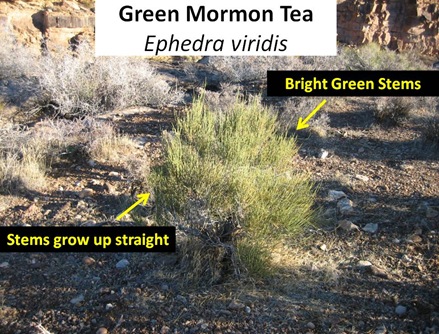
E viridis Torrey Mormon Tea , Ephedra torreyana, looks different in 2 ways. First is the color; the Torrey Mormon Tea is a light blue-green, almost pale in comparison to E. viridis. Second is the stem architecture, or “geometry”. Unlike the stems of Green Mormon Tea, those of Torrey Mormon Tea branch out at sharp- almost right- angles, in a form that is vaguely similar to that of Blackbrush.
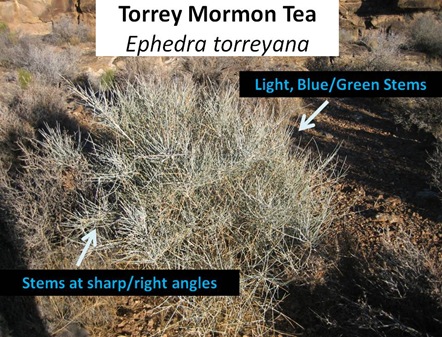
E torreyana The two species overlap extensively on the “Floor” but don’t seem to hybridize much if at all. Of the two, Torrey is the more thermo-philic; it thrives down as low as 1,500 feet, but rarely occurs at over 6,000 feet. Green, on the other hand, hardly gets lower than the “Floor” (2,500-3,000 feet), but has been found as high up as 10,000 feet. Though the 2 species exist here in roughly equal numbers, when we get up on the Mesa level the Green will dominate.

The Floor is also interesting botanically for 2 things that are not here. The first is trees. The plants down on the Floor are all shrubs. Though some “trees” (Juniper, Turbinella Oak) do grow along some of the wash bottoms, and real trees (Cottonwoods) grow along the Virgin and Santa Clara Rivers, they’re otherwise absent from the Floor. The shade-less singletracks around St. George, great as they are, are no place to be riding mid-day in summer. Utah Juniper, the toughest, most drought-tolerant Utah tree, and the first to appear as you move upslope, can’t hack the brutal heat and dryness of the Floor in summer, and the spectacular Joshua Tree don’t quite make it up to this high, northernmost fringe of the Mojave. (The ones in the I-15 median don’t count; they’re planted.)

VR Gorge But after the ride, if we pop back in the car and drive another 10 minutes down I-15 in Arizona, all of that changes as we plunge into the Virgin River Gorge (pic right) and transition into the Basement. Suddenly we’re in the real Mojave, and Joshua trees are everywhere. Though there’s no singletrack in the Gorge, the convenience and accessibility of this part of the Basement make it well worth the short drive. Pull off at the rest/area campground about 10 minutes into the gorge and spend a little while poking around.

Tangent: If you want to ride amongst Joshua trees, the best places to do so are another 90 minutes South, outside of Vegas. But if you’re OK with doubletrack, there are numerous old 4WD roads (and plenty of open camping) just over on the South side of the Beaver Dam Mountains, still in Utah.

The second thing that’s missing from the Floor is a shrub. One shrub we won’t see anywhere on this, or any other “Floor” ride, is Sagebrush, which we checked out back in April. It’s completely absent. As a rule, where Creosote occurs, Sagebrush is absent, and vice-versa. It’s like the 2 shrubs are Superman and Clark Kent; you never see them in the same place, even though they’re similar in profile and seem to fulfill the same role in their environment. Each is the “alpha-shrub” where it grows, towering over neighboring smaller shrubs. And each produces the strongest, most wonderful- but very different- scent following a rain. If you crack your car window in the desert on a rainy night, more often than not, the scent of one or the other will tell you where you are.

Next Up: We head upstairs…

Sunday, May 4, 2008

Monocot Week Part 3: Creosote - Way Wicked Cooler Than You Ever Knew

I love the smell and sight of Creosote on a road trip. It’s generally the sure sign that I’ve escaped the cold and reached the warmth. This isn’t always true, and reaching a Creosote-filled desert in the middle of July isn’t generally a thing to be happy about, but in the late Fall and early Spring it usually is.

Creosote, Larrea tridentata, dominates the 3 “hot” deserts- Mojave, Chihuahuan, Sonoran, in much the same way Sagebrush dominates the 1 “cold” desert- the Great Basin desert, only more so. While Sagebrush is absent from huge expanses of the Basin, it’s hard to avoid Creosote in the Mojave, unless you go up. It disappears on the flanks of mountains, but reliably reappears in the basin on the other side.

Around St. George, Hurricane and Virgin, UT, as you bike or drive about you often flirt with the boundary of the Mojave, and the presence or absence of Creosote is a clear indicator of whether you’re in or out of it. Once you leave St. George and head Southwest for Vegas, you’re in it for good.

Creosote is interesting to me because it’s like an alternate-universe Sagebrush, adapted to a hotter world. Like Sagebrush, it’s all over the place, and completely unpalatable to livestock, only more so. There’s only 2 known critters- a grasshopper and one of those “walking-stick” bugs- that can stomach the chemical in Creosote leaves. Like Sagebrush, Creosote has an enchanting signature smell, which is particularly pungent following a rain.

Tangent: I usually keep a sprig of Creosote on the car dashboard as an air “freshener” for several weeks following a Mojave road trip. When I enter the car the scent instantly transports me to someplace warm and dry…

Unlike Sagebrush, Creosote employs the resin-coated leaves-strategy vs. the hairy-leaves- strategy to avoid water loss. (Which probably makes sense, because in the “hot” deserts heat is probably the greater desiccator vs. wind in the Great Basin Desert. I don’t have data to back this assumption up, but I know the Great Basin Desert is colder, and it sure seems windier than the Mojave or Sonoran.)

There are other, more subtle differences. The first is a different pollination strategy. Though both Creosote and Sagebrush disperse their seeds via wind, Creosote is pollinated by insects, namely- you guessed it- wild bees. (Man, I just love wild bees- they keep turning up everywhere!) And one of the most important of those wild bees is a monolectic bee- Trachusa larrea. This is the 2nd monolectic pollinator we’ve met this trip, and it’s worth noting that if you’re going to go the monolectic route and hedge all your bets on just one flower, Creosote sure seems like a safer bet than the (endangered and very rare) Bear Claw Poppy. I was particularly fortunate this past week in that the Creosote was in full bloom almost everywhere I went- only the 2nd time in a dozen years I’ve been able to time a Mojave trip so well. Wherever I went- St. George, Hurricane, Vegas, Boulder City, the Tule Desert- the desert flats were tinged with millions of tiny yellow blossoms, adding a welcome dash of color to the otherwise brown/olive/dull green of the Mojave basins.

The second important difference is that Creosote frequently reproduces by cloning via its root structure (which is different from stem-layering, which we've encountered a couple of times (and explained with the help of an equally lame graphic)) and this is one of the most fascinating things about this plant. Now cloning via roots isn’t all that amazing; lots of plants do it, including oaks and aspen. But what is particularly interesting about Creosote is that until around 12,000 – 15,000 years ago, Creosote was completely absent from the continental US. That’s right- all of those endless creosote-filled valleys you drive across on desert road trips, only 15,000 years ago, they were all filled with something completely different (probably Sagebrush.) That alone gives one pause, to think how much the world has changed in a timeframe only a little longer than human beings have been living in cities or practicing agriculture. But what’s even more amazing is that because Creosote clones expand in concentric circles that can effectively be dated, botanists have found ancient, continuous clones dating back almost 12,000 years, meaning that these clones, these organisms, are the actual original Creosote invaders at the end of the last Ice Age.

The most famous of these ancient clones, dated to 11,700 years ago, is the Victorville Clone, outside Victorville, CA. I’ve also found a single reference to a possible 18,000 year-old clone outside Yuma, AZ. If these clones can be considered a single, continuous living organism (still somewhat of a contentious issue), then these are some really, really old creatures- way older than the oldest Bristlecone pines. (Though not as old maybe as some Aspen clones, which we can talk about come summer…)

The third really cool contrast between Creosote and Sagebrush is in how and where it exhibits polyploidy. We’ve talked about the varying levels of polyploidy in different species and subspecies of Sagebrush, (and we also looked at polyploidy in Dandelions - seriously, how cool was that??) and Creosote also exhibits significant polyploidy, but what’s so interesting about polyploidy in Creosote is that it’s almost entirely geographic in occurrence. Everywhere I went last week, wherever I saw Creosote, and for that matter, clear across the Mojave- St. George, Vegas, Barstow, Victorville- every Creosote bush has 78 chromosomes. But if I caught a flight to Phoenix or Tuscon, and stopped in a vacant lot by the airport to pick a sprig of Creosote, or headed out into the surrounding Sonoran Desert to do the same, every Creosote bush would have only 52 chromosomes. And if I took a plane to El Paso instead, and picked a sprig from the surrounding Chihuahuan Desert, every Creosote bush would have but 26 chromosomes. That’s right- all Chihuahuan Creosote is chromosomally diploid, all Sonoran Creosote is tetraploid, and all Mojave Creosote is hexaploid. The 3 varieties aren’t yet considered separate species, but they may well be on their way.

And that’s what’s so cool about Creosote- it’s a living snapshot of the world in transition. Of the transition from Ice age to Interglacial flora, with the actual, living pioneers of that transition still present. And of the transition from a single to possibly 3 new future species, with the transitional stages just a day’s drive from each other.

Alright already- enough shrubs! On to the Best Monocot Ever.