Note: In a comment to Thursday’s post, a reader- let’s call her KristenT- requested more long posts*. Kristen, here’s your post.
*So if you don’t like how ungodly long this post is, blame her.
This Part, Like So Many Of My Intros, Seems Like A Tangent, But Will Turn Out Not To Be
One night last week Awesome Wife and I were out in the front yard with the Trifecta when a couple of elderly neighbors- let’s call them the “Sontags”- who live about a block from us walked by. We see these neighbors maybe once or twice a year, and so when we do, we stop for a polite chat.
We have several couples like these in our ‘hood- older couples whose children have long since grown up and moved away, and who’ve lived in the neighborhood so long, I think they probably brought their stuff in on handcarts. Seriously, they’ve lived here for many, many, years/decades.
Tangent: Here’s something weird. We have a number of elderly couples in our neighborhood, both Mormon and non-Mormon. Strangely, all of the elderly couples who go for walks together are Mormon. This isn’t true for younger couples or families- just old folks. Even more strangely, of the few* old folks in the ‘hood who’ve ever snapped or scowled at our kids, all are non-Mormon. Huh. I wonder if there’s a lesson there. Get me a handcart.
*OK, just 3, so it’s not a very scientific sampling…
Awesome Wife and I refer to these semi-annual old-neighbor chats as the Standard Old Mormon Neighbor Conversation, because although the details vary, these conversations always follow the same 3-point outline:
1- A brief review of who we are, when we moved to the neighborhood (7 years ago), our childrens’ names, genders and ages. While it may seem silly that we have this conversation after so many years, it’s spurred in part by the fact that we don’t attend the local church (ward) and our kids don’t attend the local school*.
*The Trifecta attend public school, but a different school than that for which we are zoned. Long, not very interesting story.
This first stage of the conversation invariably concludes with a firm declaration/affirmation on the Importance Of Family. This is of course a big theme in Mormon culture and theology, and many Mormons- particularly older Mormons- will emphasize this theme in discussions with non-members, presumably because it’s an appealing, unifying theme on which people of all faiths can agree.
Tangent: Awesome Wife and I have joked that once- just once- we should disagree with this declaration/affirmation. We’d say, “Really? You think so? Man, our kids are a total pain in the ass. We really miss the days when we could stay out late and do a lot of drinking and partying…”
2- Reminiscence of How the Neighborhood Used to Be. This part involves the same story, which was really charming the first 15 or 20 times we heard it. Our house was one of the last to be built in the ‘hood, and apparently for years the local teens used to have bonfires on our lot and hang out and have a good time*. We’ve heard this story so many times now that we almost hear a vaguely passive-aggressive tone in it, as though we somehow took away the bonfire site. We want to say, “Hey, we didn’t build the place; we just showed up and bought it…”
*The telling of this part always involves “hot cocoa”. It’s like the Old-Generation Mormon analog for beer. The New-Generation analog is Diet Coke.
3- A Review of the Formidable Phylogeny of The Older Couple’s Family. Like old folks everywhere, the couple we’re chatting with will be proud of their children and grandchildren. Being Utah Mormons, we’re almost always talking about LOTS of children and grandchildren, which means that we can never follow along with this part of the conversation and get lost in a jumble of names, ages and professions. Now I know that if I really, really tried and understood the structure of their extended family, then these stories would make a lot more sense, and I could really appreciate the significance of the family members discussed and the relationships between them. But given that I only really chat with the “Sontags” once a year or so, it just doesn’t seem worth the investment of time and focus to really understand their family phylogeny.
Remember this last point. I’m coming back to it.
The Real Post Already
 Friday I did one of my favorite mtn bike rides, the Mid-Mountain/ Wasatch Crest loop. The ride is wonderful for so many reasons- fast, smooth trails, wonderful views- but I particularly like it because it showcases so many of the plants I’ve blogged about*.
 Side Note: Our wet June has left Mid-Mountain and the Crest in the best, tackiest, smoothest shape I have ever ridden them. Out Of This World Great.
*It was even worth the roughly 24 hours of bad home-front karma I endured (i.e. I was way in the doghouse) for being a couple hours late. For some reason I always chronically underestimate the time required to complete this loop. Maybe I should quit stopping for so many photos. Oo- that reminds me: Camera-Holster 2.0 is a total winner, and I’ll blog about it in an upcoming post.
 The ride took me past so many of my favorite Wasatch trees- Aspen, White Fir, Subalpine Fir, Engelmann Spruce, Limber Pine, Curlleaf Mountain Mahogany, Gambel Oak, Bigtooth Maple- and I counted at least 32 different wildflowers blooming trailside (all but 2 of which I’ve already ID’d.) After 15 months at this project a ride like Friday’s, even though I was solo, felt almost like a reunion with old friends.
 When I first began paying attention to plants, I started with trees. They’re big, they get your attention, and there aren’t very many different ones in the Wasatch, so they’re easy to get into. Over the past year, I’ve paid more attention to forbs (non-woody flowering plants.) Their flowers make fun and easy keys for initial identification, and as I’ve gotten to know them, their leaves and stems have become familiar as well, such that I now recognize a fair number of forbs when they’re not in bloom.
But even if you know every tree and wildflower in the Wasatch, you’re still missing out on a huge portion of the living biomass all around you: shrubs.
Shrubs And Me
The term “shrub” drives me a little crazy; it’s such a catch-all. The very first shrubs we looked at in this blog were desert shrubs- things like Sagebrush and Blackbrush and Creosote. These are clearly “shrubs.” They’re certainly not trees, but they’re bigger than forbs or grasses. They stand more or less alone, and they’re rarely higher than chest height.
But then we moved up into the foothills, and things started to get a bit more complicated. Instead of just standard “shrubs”, we also now had sorta-kinda shrubs, things like Scrub Oak and Bigtooth Maple and Mountain Mahogany that sometimes were shrubs, but other times were clearly trees.
 And then when the Aspen and PLT forests melt out and you move up above 7,000 – 8,000 feet, “shrub” means the confusing jumble of waist-to-chest-high leafy stuff growing on the forest floor. 2 of these- Serviceberry and Chokecherry- we’ve already identified, but those were the easy ones, as they often grow out in the open as well, where they can easily be picked out. So starting today I’m going to start picking off the leafy understory shrubs, not all at once, but one every week or so throughout the summer.
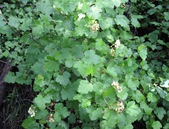
 For the past couple of weeks this guy’s (pic left) been driving me crazy. It’s real common up above 7,500 feet, grows chest-high or so, always in the shade, and has palmately-lobed leaves with serrated edges. It looks a lot like some type of currant or gooseberry maybe, and so I suspected it was a member of the genus Ribes. But nothing fit.
 Then about 2 weeks ago it started flowering. And the flowers (pic right) didn’t look anything like any kind of currant flowers. Rather they looked a bit like Chokecherry flowers, or other flowers of Rosaceae, the Rose family, with 5 petals, and numerous stamens. And later that day I easily ID’d it: Ninebark, Physocarpus sp.
 There are ~10 species of Ninebarks in North America, occurring naturally in every state except Hawaii, Louisiana and Mississippi. 2 of those- Mallow Ninebark, P. malvaceus, and Mountain Ninebark, P. monogynus- are native to Utah. They look aggravatingly similar, but I’m inclined to go with Mallow Ninebark, as it favors richer, damper soils, which is where I almost always seem to spot it in the Wasatch.
 The plant is named for its peeling bark (pic right), which supposedly can be peeled 9 layers deep, though my own efforts only isolated 4 or 5 layers before hitting bare wood. Currant bark doesn’t peel the same way, so it’s a quick identifier between the two. In any case, once you ID it, you start seeing it all over the place.
What threw me off of course is that the leaf shape didn’t make me think of the Rose family, and I when I finally ID’d it I thought, “Wow another Rosaceae…” Seriously, I can’t think of how many times I’ve ID’d a plant over the last 15 months, looked it up and read “…a member of the Rose family…” It’s not just when I’m out in the backcountry. In my yard, in my kitchen fruit bowl, in the supermarket- I see members of this family everywhere. Unlike the “Sontags”, I run into various members of the Rose family every single day of the year. And so over the long weekend I thought: Maybe it’s time to figure out what the deal is with this family, and understand just who’s who and how they’re related to everybody else.
All About The Rose Family
 There are over 3,000 species in the Rose family, including everything from Apples to Pears to Peaches to Almonds to Raspberries to (of course) Roses. In this blog we’ve looked at numerous other members of the family, including Blackbrush, Cliffrose, Bitterbrush, Wild Rose, Mountain Mahogany, Thimbleberry, Serviceberry and Chokecherry. In the backcountry or the backyard you can’t swing a dead cat without hitting a Rosaceae, and they’re arguably one of the most successful families of angiosperms. It’s amazing that this huge array of trees, shrubs and forbs are descended from a common ancestor that probably lived sometime after the last T. Rex keeled over, likely in North America*.
*Apparently the oldest fossils that are clearly Rosaceae date from the Eocene and have been found in Washington state and BC.
But what I really wanted to know was how all these things are related to each other, and to that end I managed to dig up some light weekend reading: Phylogeny and classification of Rosaceae, D. Potter et al, 2006.
All About Scientific Papers, Why They Are So Boring, And Why Snark Is Important To Science
Tangent: Over the course of this project I’ve read or skimmed several dozen (maybe 100+?) Scientific papers and read/skimmed several hundred abstracts. When I first started reading such papers I was amazed at just How Phenomenally Boring they are.
I naively expected that scientific papers would begin with astounding breath-taking discoveries, like you see in the headlines of supermarket tabloids. You know, stuff like “Frozen Neanderthal Discovered In Antarctic Ice.” But no, they usually start off with an abstract that briefly highlights the goal of the research and ultimate findings in very non-exciting terms, like,
“Phylogenetic relationships among 88 genera of Rosaceae were investigated using nucleotide sequence data from…Zzzzz”
Nested Tangent: These abstracts- strangely enough- often start out in the 3rd person. Why is it in the 3rd person? Did you investigate the relationships, or was it some other guys and you just happened to be hanging out in the lab? Maybe it’s supposed to be like a book jacket or something, written by a “neutral” 3rd party…
From there the paper goes into the introduction, which although brief, is often the most valuable part of the paper to a layman, because it’ll identify other, earlier papers that often are more relevant to the topic you’re trying to figure out than this one.
After the Introduction, the paper gets into the longest, most detailed, most phenomenally boring heart of the paper: Materials and Methods. Reading through this section is borderline-impossible for a layman, and is probably one of the 4 most boring things I’ve ever attempted. Here’s an actual excerpt:
“GenBak 18S sequence of Primus persica, Spiraea x vanhoutei, and Photinia fraseri were used to design a forward (18S1F: GACTGTGAAACTGCGAATGGTC) and a reverse PCR primer (18S2R:GTTCACCTACGGAAACCTTGTTACG) as well as two internal primers…”
And it goes on like this for pages and pages! Finally the paper gets to “Results” followed by “Discussion” which has (or doesn’t have) the nuggets of actual helpful information you were originally hoping to find.
When I first started reading scientific papers, I wondered: Why all the boring “Materials and Methods” stuff? Who cares? But of course over time it dawned on me: Other scientists care, because it’s the only way to keep researchers from Making Shit Up.
Here’s something I’ve learned about Real Scientists. They are- by and large- snarky. If you spend much time reading scientific literature, you’ll soon notice that scientists are often picking apart, questioning or downright refuting the results of other scientists. The only way to defend yourself against the continual onslaught of Snarky Scientific Critique is to document the living daylights out of what you did and how you did it.
Nested Tangent: Of course, Scientists aren’t actually any snarkier than middle-aged men are in general. But- and here’s the critical distinction- they’re snarky and informed, unlike regular, uniformed middle-aged snarky guys who just listen to talk radio and snark about the government or immigrants or whatever
When I first noticed this I thought: How annoying. These guys spend so much time snarking at each other, and defending each other from snark, that their papers are almost unreadable. But as time as passed, I’ve come to see that Snark isn’t a distraction from science; rather it is a core principle of science and – I believe- the very foundation of the modern scientific method.
Science works because it is self-correcting. Old, bad hypotheses and theories get questioned, changed or eventually thrown out, not because some nice smiling old tweed-wearing gentlemen agree to it over tea, but because legions of snarky scientists are constantly duking it out. Critics of science (who always seem to know the least about it) sometimes claim that science is just another system of belief, like an ideology or a religion. But religions or ideologies don’t constantly correct and change themselves through ongoing internal snark. And while this continual snark-fest may seem bizarre to the casual observer, it eventually puts men on the moon, eradicates smallpox and frees wrongly-convicted inmates. Snark delivers.
Genetic research in recent years indicates that some of the traditional groupings within Rosaceae may be paraphyletic and Rose family tree is in flux. The findings in Phylogeny and classification of Rosaceae seem to indicate that Rose family consists of 3 major ancestral branches, about which there are 2 really cool things. The first is that all 3 occur all over the place right here in Utah, and the second is that we’ve already looked at oodles of members from all 3 branches.
 The first, and most distantly related, major branch includes things like Roses and Raspberries. Wild Rose and Thimbleberry (pic right) are 2 examples we’ve looked at, but in addition to the Raspberries and Blackberries it also includes Strawberries, Cinquefoil, Apache Plume and garden herbs, like Lady’s Mantle.

The second (and smallest) branch is the one most people don’t think of having anything to do with Roses.  It includes Mountain Mahogany (pic left), Cliffrose, Bitterbrush and Dryas (Mountain Avens). This branch is cool not only because it contains so many foothill and desert plants we’ve looked at in this blog, but also because- with the exception of Dryas- it’s strictly limited to Western North America. These are our “roses”, and though small, this branch has evolved everything from full-on trees to arctic wildflowers to live-saving shrubs.
 The third branch is by far the largest and includes not only so many of the plants we’ve looked at in this blog- Serviceberry (pic right), Chokecherry and wild pear- but also practically half of everything in the fruit section at the supermarket, including cherries, peaches, plums, almonds, apples, pears and so much more.
 One of the interesting things in the results of this paper is which plant belongs to which branch. Here’s a quick example: Blackbrush (pic left). Dry, shrubby, scratchy, with tough little waxy leaves. I would’ve bet for sure it’d be in the Mountain Mahogany-Bitterbrush Group. But it’s not; it’s in the Apple- Serviceberry group, and actually appears to be more closely-related to Apples and Pears than are Peaches or Plums!
 But the most interesting thing from the results is the relationship between kinship and form. Historically species within the Rose family have been grouped according to form, such as fruit structure, under the presumption that species displaying common form shared more recent ancestry.
  But the shocker of the paper is this: species with similarly-formed fruits, or floral structure, trees, herbaceous plants and even specific chromosome counts have evolved independently, multiple times within the family. Trees are an easy example: Mountain Mahogany and Pear trees (pic left) evolved their tree-ness completely separately.
Conjectural Tangent*: Though the paper didn’t state it, I assume that the common proto-Rosaceae ancestor was woody, because all Rosaceae trees share the same common eudicot standard wood architecture. This in contrast to say the monocots, in which various trees display wildly different wood architectures (think Palm vs. Joshua Tree), each having “re-evolved” wood from a presumed herbaceous common ancestor.
*Yes, this is a new kind of tangent (hence the new color), which involves me going off both randomly and half-cocked.
But here’s a cooler example: “drupaceous” fruits (think “stone” fruits) have apparently evolved independently 4 times within Rosaceae. (Though to be clear, the common “stone” fruits we think of in the supermarket- cherries, plums, peaches, almonds and apricots- are members of the genus Prunus and are apparently monophyletic.)
Over and over again in this blog, without intending to, I keep coming across example after example of convergent evolution.  C4, CAM, Hummingbirds and Hummingbird Moths, Old and New World Vultures- even the amino acid substitution in the opsin genes of humans and butterflies- all of these are wonderful examples, but to see such richness of convergence in a single family of flowering plants really brings home the power, ingenuity and beauty of evolution. Think about that the next time you admire a Rose.
*I mean, a real, WILD rose, not those phony petalized-stamens freak show things you buy at the florist…

 Physocarpus’ closest relatives- excluding a couple of things you never heard of*- turn out to be Prunus, which of course includes its frequent neighbor in the Wasatch, Chokecherry (flower pic, right).
*Like Catalina Ironwood, Lyonothamnus floribundus. See, I told you- you never heard of it.
Ninebark’s shade-tolerance makes it a wonderful shrub for North-facing gardens. Although most nurseries sell cultivars of Eastern Ninebark. P. opulifolius, the plant reproduces readily from cuttings, so there’s nothing to stop you from “shopping” for a bit on your next ride/hike.
 I left the best thing about Ninebark for last. As a mountain biker, it is about the most benign shrub to crash into in the Wasatch*. Just be sure to close your eyes tight before you hit.
*Except for Thimbleberry. Way, way soft. Like toilet paper, which it works great as, by the way.


