May 2010- Yeah, that's right. I stuck it back up. I always liked this post and was bummed to have to pull it. It was a while ago, and the neighbors mentioned here recently moved away. Sometimes things just work out.
Note: This one is long and weird*.
*Yes, I know that most (all?) of my posts are long and weird, but this one is long and weird even by WTWWU standards. I just had a lot of ground I wanted to cover.
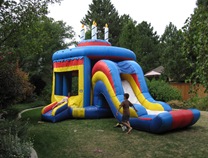 I woke up Sunday morning in a foul mood, after a fitful sleep. Earlier last week, Clean Colin had invited us to a BBQ at his place Saturday night. I was excited to go; several good friends would be there, and rumor has it that Clean Colin- an accomplished chef- makes an outstanding burger. But when I mentioned it to Awesome Wife, she reminded me that she’d already invited a few neighbor-couples over for drinks and dinner, following the Twins’ birthday party that afternoon. (pic right = party setup in backyard*)
*Yes, my lawn looks pretty beat, but it actually looks way better than it did a month ago, when I almost killed it.
So I was a little disappointed, but not too much. We have- as I’ve blogged before- some really great neighbors. As it turns out, we also have some not-so-great neighbors.
I mentioned in a post a couple months back how happy I was that a new family had moved into our neighborhood. Now, I’m not so happy. I won’t get into details, but I’ll give you a little hint. As longtime readers know, when I blog about various friends, associates or acquaintances, I give them nicknames. My nickname for the female half of our new neighbor-couple is “Ann Coulter”*
*No I don’t have a nickname for the male half yet. Everything I’ve come up with so far involves a part of anatomy.
So it wasn’t a great night, in part because of obnoxious guest behavior, in part perhaps out of the realization that the new neighbors wouldn’t turn out to be great friends after all, but also, I am chagrinned to admit, because of my own behavior. I could/should have just shut up. I could/should have smiled blandly as I was rudely interrupted and berated in my own home. I could/should have bit my lip as I was lectured with falsehoods by a couple of self-serving, screw-the-poor jerks… But I didn’t. Something sparked inside. Something about being “town-halled” in my own home, and a light went off in my head that said “NO”, and I gave it right back, refusing to be interrupted or talked over, and in less than a minute we were yelling, talking over each other…
I wish I’d just shut the hell up. They were only over for the drinks part anyway. I could’ve shut up, then bitched later on to Awesome Wife about how awful they were, and never, ever invited them over again. But I didn’t. That spark, that same inner spark, that drives my enthusiasm, my love of life and the natural world, that pushes me through tough spots in races and out of jams in the backcountry, it got the better of me.
So I woke up feeling crappy, and ready to ride hard.
The Ride
OCRick, Clean Colin, Vicente and I drove South an hour to Spanish Fork Canyon, then East and up into the Southern Wasatch , then turned North up Diamond Fork drainage. Right away, Diamond Fork looks different than the standard Wasatch side canyons. It’s broad, and the sides are rolling grassy hills, dotted with widely spaced scrub oak and Juniper. The hills are golden in late summer, and the first time I drove up, years ago, the impression I had was of somewhere in Central California, between the Central Valley and the coast. In the center of the valley runs a beautiful, winding shallow clear river, lined by cottonwoods. The road is paved but twisty, and driving from the mouth of the canyon to the trailhead takes about 15-20 minutes. By the time you get there, the sprawl and smog and heat of the valley seem hundreds of miles away. There’s a network of trails that can be accessed from here, following the various creeks, streams, and draws that drain into the river from the Eastern slope of the valley.
 There are 3 main routes for the “Diamond Fork Loop.” The first and easiest climbs Second Water drainage to a paved road (Rays Valley road) then follows that paved road North until it intersects Fifth Water drainage, then descends back to the trailhead. The second route continues up Second Water, past the road, clear up to Strawberry Ridge, where you continue on an old jeep road that straddles the ridge separating Diamond Fork and Strawberry drainages before dropping down Fifth Water from the top. The third, least traveled, toughest- and our favorite- route lies in between the first two, and uses an old, neglected, overgrown, technical singletrack called the Center Trail to forge a path in between the ridge and the road.
All About Riparian Riding
The trail up Second Water is twisty, windy and fun, but that’s not what makes it worth the drive for me.  The trail follows a stream and runs almost entirely through a riparian zone. Riparian vegetation is that which occurs right along streams in otherwise dry country, usually in a belt between 10 and 80 feet wide. Standing along a stream in these parts, you can be surrounded by tall cottonwoods, box elders, alders, water birches, and maples, while 20 feet away from you is a gravely slope covered with juniper, yucca, sage, and prickly pear. Riparian zones aren’t- or weren’t- uncommon in the Intermountain West, but trails through them- particularly bike-able trails- are extremely rare, for two reasons: First, as a rule of thumb, most easily accessed trails in the West are on public lands. Most public lands are administered by the Forest Service or the BLM, and generally these 2 agencies, when they were formed, lapped up lands that hadn’t been homesteaded or otherwise claimed by settlers. Settlers when they arrived naturally chose the lands with the best water. River Valley bottoms were the best, as they offered both farming and grazing, and this explains why you almost never find public lands in broad river valley bottoms in the Intermountain West. But riparian zones were also desirable. The density of lush vegetation in riparian zones makes them far better grazing areas than the surrounding hillsides. Thus, today a high proportion of riparian zones today lie within private lands.
The second reason is that those riparian zones that lie within public lands are often some of the most heavily used, abused, and overgrazed areas you can find. Excessive grazing removes the low-lying vegetation that holds the stream banks together, allowing the streams to erode dramatically. All this means that there aren’t that many riparian zones on public lands in good condition, and there are even fewer such zones with well laid-out trails. When you do find one, riding can be wonderful. The tall leafy trees are reminiscent of riding in the East, and the fact that the trail follows a watercourse usually means that elevation changes gradually, and the trail twists and weaves its way up or down the canyon. Riding the trails in the Diamond Fork area is often surreal- pedaling through a damp, sometimes steamy forest, with semi-desert hillsides a stone’s throw away.
Back To The Story
Together we wound our way gradually up the canyon, following the stream, through the lush riparian forest. About 5 miles up we climbed up and out of the forest, and through a series of pastures before reaching Rays Valley Road. We regrouped, greeted a group of bowhunters coming down the trail, and continued up.
It’s been a dry couple of months, and most of the Diamond Fork trails are worked pretty hard by cattle and, to a lesser extent, motorcycles. As the grade stiffened we battled our way up eroded troughs filled with moon-dust, huffing, spinning and dabbing our way up to the junction with Center Trail.
 Between Second Water and Fifth Water trails, Center Trail climbs 5 times and descends 5 times. Each climb is stiff and fairly technical, and a couple of the descents are a touch hairy right now, due in part to the dust. The climbs are all South-facing, working their way up hot, Scrub Oak-covered hillsides, while the descents are through cooler, North-facing Aspen and PLT forests. On the tough climbs, we gradually strung out, each rider picking the pace at which he was most comfortable negotiating the rocks and dust while maintaining a ride-able line. We’re all strong climbers, but my race-seasoned legs settled into a slightly faster pace, and soon I was climbing alone.
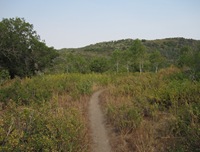 Everyone has their own tonic for a sour mood; some of us just take longer to find theirs. Mine, which I found in my 30’s, is a tough, technical climb on a clear day. The exertion, focus and light work together for me to bring a clarity of mind that helps me disassemble, parse and work out the things that are eating at me. As I pulled away and rolled up one ledge after the next, I mulled over the previous evening. On the first climb, I mainly chewed myself out.
 At the top of climb #1, the trail rolls into an Aspen grove and then opens into a small meadow. I pulled over in the shade and one by one the guys joined me- Clean Colin, Vicente and finally OCRick. The shade and cool breeze was a welcome break from 2 hours of climbing. We sat on the grass, de-helmeted, ate, and lingered for a bit, none of us in a hurry to get rolling right away. Finally OCRick rallied us and we continued, dropping down the North side.
 I called a quick halt about 100 yards down the trail. To the right here, easy to miss while you’re descending fast, is the largest- or at least fattest- tree I’ve come across in the Wasatch. It’s a White Fir, and this shot doesn’t do it justice (Colin is too far in front of the tree.) It’s probably about 5’ in diameter at chest-height.
Side Note: For Northwest readers, I know this is not all that impressive a tree. But here in the Utah it’s a giant.
I only know of a couple other trees like this along the Wasatch Front. I don’t know if it’s just a lucky escapee from past loggings or fires or blights or what, but its sheer mass makes it remarkable in this part of the Wasatch. I always like to stop to check it out when we pass through every couple years or so, and my friends- who’ve known me long enough to tolerate my various tree-obsessions- always indulge me.
The first descent included some rocks, roots and some sketchy pools of moon-dust, but we arrived crash-free at the bottom, crossed a small stream, and began the 2nd climb, breaking out again into the open. As before, I soon pulled ahead.
I wonder if my disappointment with the neighbors was in a sense heightened by surprise- they seemed so much like us. It’s not like everyone- or even most people- especially in Utah- agrees with my views on politics or values or ethics, and that rarely upsets me. I’ve been part of political and religious minorities here for over a decade, and it hasn’t really detracted from my great experience living here. But these people weren’t regular Utahns. They were like us- out-of-staters, well-traveled, outdoor-oriented, social drinkers, blah blah- and this similarity somehow made our wildly differing values more shocking, more alarming, more wrong.
 At the top of the next climb, I rolled over the open knoll, and came to a stop in the shade of the Aspens. There was a breeze, and the leaves rustled overhead. Below the Aspen canopy was a stand of Serviceberry shrees*, branches loaded with berries, and I absentmindedly remembered that summer was ending. Vicente rolled up, then Colin, then Rick. We dropped down descent #2, zipping through forest again, on a trail faster than the first descent. We bottomed out, shifted into granny gears, and began grinding up, stringing out all over again, each in his own, hot dusty thoughts.
*New word. More than a shrub, but not quite a tree.
The False Bond Of Unbelief
In particular, I’d heard through the grapevine that they were fellow non-believers. That’s right, atheists. As longtime readers know, I’m not a theist, or a believer in a religion or god or what-not. But I don’t generally use the term atheist. I’m not offended by it, but it carries all sorts of cultural baggage, and more to the point, it doesn’t tell anyone what I believe; it just tells them one very specific thing that I happen not to believe. In general, it’s not a big deal. I have many “believing” friends, and I certainly don’t consider “disbelief” to be any kind of requisite for friendships. But I’d be lying if I didn’t admit that sometimes, when I learn that a friend or associate is also a non-believer, I feel just a teeny little twinge of camaraderie or even brotherhood. Atheists are in a weird position in American culture- the term is used by so many as a synonym for lack of morals or values, and poll after poll shows that an “outed” atheist would be virtually unelectable to public office. And so sometimes, when I learn someone is also a non-believer, I sense-or perhaps make the mistake of sensing- some common ground in world-view and values.
 At the top of climb #3 there was one of those super-ATVs parked- the ones that have a roof and look sort of like a baby Hummer. It had come down via an old jeep trail running down from the ridge, probably carrying bowhunters. As we waited and re-grouped, a group of several dirt bikes passed us. We waited a few minutes for their dust to settle before continuing.
Tangent: Though motorcycles can and often do cause considerable wear and tear on trails, I’m far more favorably disposed toward them than I am ATVs on trails. They don’t turn trails into roads, operating them requires some skill, and their riders seem to take safety (gear, terrain, speed) much more seriously than typical ATVers. In fairness, they’re also far fewer in number…
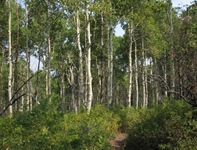 Descent #3 was the smoothest and fastest yet- winding through fast, dusty S-Curves, shrubs and grasses brushing against our shins. The best descent yet, it was over too soon. We bottomed out, wheelied across a mud-bog, and started the fourth climb. Though we strung out again, it was a relatively short ascent, and the easiest so far.
The assumption of “common values” between non-believers is not completely baseless; 83% of self-described agnostics or atheists voted for Kerry in the 2004 presidential election*. But it’s folly to assume it a rule. Non-believers hold all sorts of different values and views. One non-believer perspective I run across from time-to-time is a sort of Libertarian world-view, advocating strong freedoms for individuals, along with minimal government interference, involvement or support in the lives of citizens. On the surface this perspective, and Libertarianism in general, is based on sound logic; individuals thrive given freedom and opportunity, and societies that suppress such freedoms inevitably stagnate.
*Sorry, I can’t remember the source. Pretty sure it was the Economist, but can’t swear to it.
But when you really talk to many so-called Libertarians, a dark, accompanying undertone often appears- a weird, almost eugenic theme of pseudo-social-Darwinism, of leaving the weak, the less capable, the less deserving to their own devices. A theme that sees a ”justice” in such “survival of the fittest”, because it somehow is thought to emulate the “natural order” or progression of the world. (I find such a theme/tone repelling, not only because it runs so counter to my own values, but because it always seems that the people who long to apply “Darwinism” to socio-politics are folks who don’t understand jack about how evolution and natural selection actually works.)
 Climb #4 was short but I’d still gotten out a bit ahead. I rolled again up further just a bit to wait in the shade. The ride was gradually unwinding my frustration, my tension, my anger. The breeze had kicked up and the Aspen leaves rustled loudly. Aspen leaves- as I’ve blogged previously- have a stem architecture that causes them to swish back and forth sideways across each other in the wind. The swishing sounds a bit like whispers, or even soft voices, and sometimes, when I’m alone in an Aspen forest I find myself unconsciously straining to hear the words… as if I could just listen a little more closely, maybe I could make it out…
 Way back when, when I was into science fiction, I read a story of some people who landed on an alien planet. Before they landed, their instruments warned them they could live there, but only for about a month. When they landed they were so relaxed, so at ease and so calmly enchanted with the place that they lost all sense of time and urgency and surely would have lingered until they died, had it not been for their pesky-yet diligent Spock-like* fellow-astronaut.
Tangent: Every sci-fi story, movie or series has a Spock-like character. It may be an alien, or a robot or a hot cyborg in high heels*, but there is always a Spock-like-voice-of-logic-sounding-board character.
*Yes, Seven of Nine’s outfit in STV actually included high heels.
 Waiting at the top I had just a tingling of that same weird sense. That I could stay here for another hour, the afternoon, maybe days even, and that if I just opened my mind and listened real carefully, I could maybe make out… Colin rolled up, snapping me out of my reverie. Vicente was close behind, and finally, a hot, tired and grumpy-looking OCRick. Whatever was on his mind, it wasn’t Aspens whispering, old sci-fi plots and hot cyborgs. No, it wasn’t at all- in fact it was me.
“Hey! “ he snarled, pointing at me, “How ‘bout you go last the next descent?” Feeling suddenly sheepish, I realized that I’d been blasting the lead down all the descents, choking and blinding my companions with dust. I apologized and promised to “sweep.” The 3 rolled off before me, and I lingered for a moment to let their dust settle. Not too long though, lest the Aspens charm me again…
 The 4th descent was smooth and quick, and I was soon climbing again, grinding my way up climb #5. At an early switchback Colin spun out and quickly stepped aside, letting me pass. I settled in behind Rick.
 People will always hold different views, and try as you might, it’s ultimately impossible to fully comprehend the motivations and drivers behind a set of values and beliefs radically different from your own, and whether those beliefs are truly held, or serve primarily as a rationalization for existing desires or self-interest. And to be completely honest, it can be tough to determine whether our own values and opinions reflect what we really believe to be right, or our just our self-interest, or something in-between.
Midway up climb #5, the trail eased off a bit and entered a stand of Aspens. At a wide spot, OCRick pulled over. “Go ahead, I’m trashed.” I mumbled something encouraging and kept on climbing.
Tangent: OCRick is 18 years older than me, but only on the longest, hardest climbs do I ever wait for him. The guy is the toughest geezer I’ve ever known. Coincidentally, OCRick’s son is exactly 18 years younger than me. I like to kid OCR that when he gets too old and slow I’m going to “break up” with him and start hanging out with his son.
It so happens that OCR Jr. is 17 and 19 years older than my two sons respectively, so we can probably keep this joke running a couple more generations.
The SPT
The best values sanity-check I’ve been able to come up with is what I call the Selfish Prick Test (SPT). The SPT goes like this: Whenever your beliefs and values dictate a given position or course of action, stop and ask yourself this: If my only “value” were Being A Selfish Prick, is this what I’d do? Now sometimes, to be sure, the right thing to do really is going to happen to be the same thing a Selfish Prick would do. But if your values and beliefs repeatedly and consistently guide you to the same decisions, viewpoints and courses of action that Being A Selfish Prick would lead you to- say always denying help and support to those in need and believing the answer to every societal problem is a tax cut for yourself- then you have to ask yourself: How am I not a Selfish Prick? And if the answer isn’t clearly, immediately and overwhelmingly obvious, then maybe, just maybe, you should take a step back and reconsider your values.
I caught up to Vicente. He greeted me and then asked, “Tell me again about your job, Alex.”
ME: I sell technology research services.
VICENTE: No, no, tell me more. Tell me, on a typical day, exactly what you do, from the time you arrive in the office, to when you leave in the evening.
 I laughed, for of course I’ve done this to probably a hundred other riders on a hundred other climbs- get them talking to slow them down. But I was still feeling strong, and I was ready to take a break from thinking deep thoughts. So for the next 10 minutes or so, as we crested the final climb, I told Vicente all about my job, my day and my routine. FWIW I still don’t think he has any idea what it is I sell.
We regrouped up top and dropped the 5th descent and longest descent, me sweeping again. At the bottom we joined into 5th water trail and zipped down smooth S-curves back to Rays Valley Road. After the road, the trail passes through a gate-closed to both motorcycles and cattle- and suddenly the dust was gone. Weaving our way down the Juniper-lined trail through the suddenly-clear air, we sped down to our final stop- the Hot Pots.
All About Hot Springs
 Given how important it is in our lives, it’s remarkable how little we think about the ground we stand on. In our short little snapshot lives the planet seems static, unchanging. But of course the planet is changing constantly, and glaring evidence for the change is all around us, in hills, valleys, mountains and plains, even (especially!) in highway road-cuts. But in our day-to-day lives we overlook these features, and generally think of the planet beneath us as, well, solid. Until we see something really weird.
Hot springs are really weird.
The furthest piece of land on Earth from Utah is the Kerguelen Islands. They’re a cluster of treeless sub-Antarctic islands owned by France, inhabited only by a crew of French researchers. If you started digging more or less straight down toward the Kerguelens, you’d get there in somewhere around 7,500 miles.
After your first few hundred feet, you’d notice that the rock around you was starting to get warm. By about 500 feet down, it would be a good 7 -9F* degrees warmer. By ½ a mile down, it would be almost unbearable- 35-40F degrees warmer than at the surface. And if somehow, someway you made it down to 50- just 50- of those 7,500 miles, you’d be sitting in molten rock at something like 1500F degrees. The Earth isn’t solid; it’s a superhot molten ball covered by a papery-thin solid crust.
*Calculations, conversion all mine, and may well be way off.
Side Note: It’s actually way more weird and complicated than that. By the time you get down to the Mantle, the layer underlying the crust, stuff is thought to be solid again, but acts- in the long term- sort of like a liquid*. Further down, the Outer Core is thought to be liquid, but then the Inner Core solid. Maybe. Anyway, whatever it is, it’s way, wicked hot.
*Know what else is like that? Glass, which I may come back to as a metaphor for perception-of-self in a future post.
Hot springs are some of the clearest, easiest evidence we have of this heat. Springs- of all types, hot or cold- are outlets for groundwater. Rainfall and snowmelt that doesn’t run off into streams and rivers percolates underground and settles in deep reservoirs or aquifers. As these aquifers fill, the water level and pressure within them rises. Underground rock contains various cracks and fissures, and where water finds and easy path through such channels, springs occur. If the reservoir is deep enough- and it gets to the surface quickly enough- it’ll be hot.

 Some hot springs, like Warm Springs out the Snake Valley, are barely lukewarm, and make for a pleasant swim on a cool day. Others, like the famous pools in Yellowstone are hot enough to quickly scald or even kill an unwary visitor. But when spring water arrives at the surface between say 105F and 140F, it can be mixed with cooler surface waters and channeled into comfortable pools.
Actually it’s not that simple, because the Earth’s crust isn’t anything near uniform. In some places it’s thicker, some thinner, and when big plates of crust push up against each other the crust gets all crazy-mangled. Above ground that crazy mangling manifests itself in things like mountains, our own Wasatch an example of the crunching and buckling along the Wasatch fault.  But underground things get twisted and convoluted and mangled as well, which means that oftentimes the places where big plates of crust push against each other are also places where “hot stuff” is closer to the surface. The classic example is the so-called “Ring of Fire”, the series of 400+ volcanoes ringing the Pacific crustal plate. And where “hot stuff” is closer to the surface, the likelier it is to be in proximity with underground water feeding a spring. What this means to us is that there are lots of hot springs in the mountainous Western US- particularly in places like Idaho and Washington and Oregon and California and even Nevada.
Utah has over a dozen “soak-able” hot springs, but none near as nice as the Fifth Water Hot Pots. In the 2 years since we last visited, someone’s made fabulous improvements to the site, including several deep, rebuilt/redesigned, attractive pools downstream from the main pools.
 We soaked and kicked back in a couple of the deepest, switching between the hotter pools and the warm creek. The moon dust washed away, and when we climbed out I felt clean, refreshed and clear-headed. We zipped down the last three miles to back to the trailhead, alongside Fifth Water and then the larger Fifth/Sixth Water combined Creeks, my worries, tension and disquiet left- for the most part- scattered across the dusty hills behind.


