Note: I’m away and offline this week. I’ve set up an auto-post series of this Mexican-Tree-Adventure story in my absence.
The next morning, after a breakfast of cookies and bottled water, I left the hotel to meet Beto. Checking out of a Mexican hotel is no big deal- they’re typically cash, pay-in-advance, but leaving before sunup usually means waking the proprietor to unlock the door.
I parked in front of Moro’s house, having paid careful attention to landmarks the night before, and as instructed, rapped on Beto’s window, calling out, “¿Oye Beto, ya estas despertado?”
“Si, momentito…” came the answer.
Minutes later we were in the pickup, driving through the darkened streets of Juchipila. At the South end of town we stopped at the Pemex station to fill the tank, which was almost the only thing anyone in Juchipila let me pay for during my entire time there. Back in the truck we headed back toward the center, then headed West off the main street onto an unmarked dirt road. This was apparently the road to Pueblo Viejo; I never would have located it without asking. Almost immediately the road made a very rough double crossing of the almost-dry Juchipila River, then turned to the Southwest and began gently climbing up the West side of the valley. By this time it was light enough to see, and the road was a mess. Supposedly being prepared for its inaugural paving in the coming year, the road was an obstacle course of holes, sand-traps, and piles of gravel. Passage would have been challenging in my rental car.
 After about three kilometers, we turned onto a much smoother dirt road which was absent from my topographical map and headed due West toward the Sierra Modrones. The fields around us were open range, interspersed with patches of low, scrubby trees, mainly oaks. After another kilometer or so we passed a home on the left, and the grade of the road’s incline increased. We turned through a tight switchback to the left, approached a second switchback when Beto stopped the pickup, got out and locked the front hubs. Back in the cab, Beto shifted into the four-wheel-drive-low gears, rounded the switchback, and the real drive began.
 The Sierra Modrones are not conducive to road-building. Their flanks are steep, rugged, rocky and without significant foothills. When the Pintero brothers decided to build a road to the top, they used a bulldozer to cut the easiest path up they could come up with, but the road is, in a word, tortuous. I live in Utah, own a high-clearance four-wheel-drive vehicle, and have driven it on many difficult jeep trails. The road up Cerro Piñones is about as rough as the Flint Trail in the Maze section of Canyonlands National Park, only much longer- about 18 kilometers.
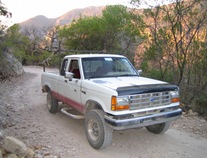 Our pickup truck was a chocolate, the Mexican slang for a motor vehicle brought down from the U.S. Beto had no idea why such vehicles were called chocolates. Our chocolate, a Ford from the early ‘90s, had seen a lot of use, apparently much of it on roads such as this. The passenger seatback was broken, tilting back at a forty-five degree angle, forcing me either to crouch forward, elbows on knees, or lie back as if in a dentist’s chair. The tires were worn down to the point where I wouldn’t have driven them on my own vehicle for a weekend away in Sun Valley, but Beto had a relaxed confidence in both his road and his chocolate. Like most Mexican drivers, Beto didn’t use a seatbelt, and not wanting to look like a pollo, neither did I.
 As we slowly climbed in the dawn light, the vegetation gradually changed from low scrub to man-high bushes and soon the first real trees appeared- some type of live scrub oak (pic right) that grew up to 15 or 20 feet in height. Twenty minutes or so later, by which time we’d climbed maybe 1,200 – 1,500 feet above the valley floor, and emerged into the morning sunlight, we encountered the first pine trees, Pinus lumholzi, a relatively rare pine endemic to Mexico easily identified by its “pendant” needles. (pic left)
  Pines have three basic types of needles: pendant, which simply hang pretty much straight down with gravity, erect, where the needles and fascicles jut out directly from the branch in all directions, and drooping, where the needles start out in all directions like erect needles, but due to their length, end up sort of well, drooping, back down toward the ground. In the US, nearly all naturally occurring pines have erect needles, but in Mexico, all three types occur, and are often a useful identification guide. (I went into the likely evolutionary drivers behind drooping and pendant needles in this post.) Shortly after breaking into the pines we stopped at a spring gushing out of the wall of the road-cut, where Beto filled a large jug (pic below right.)
 As we continued the slow bumpy climb, the views below and behind us unfolded and expanded into a spectacular vista: the long Juchipila river valley below us, extended all the down past Moyahua, and endless rows of dry, rugged mountains and plateaus beyond.
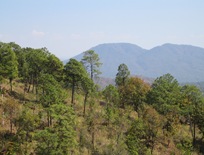 Eventually we wound our way up to the crest of the range, at about 8,000 feet. Shortly before we crested, we encountered our second pine, Michoacana Pine, Pinus michoacana, one of the most common pines in central Mexico (pic left = Michoacana pines in Michoacan), and one with which I was already familiar. Michoacana is a tall, stately pine, growing in widely-spaced groves in high, dry forests. It’s very reminiscent of Ponderosa pine with one glaring exception: it’s bright green, 8-10” long drooping needles, which give it an almost alien appearance.
  Up on the crest, the road turned to the South, leveled out, improved, and as we rolled along at nearly 40 kph, the cool, shady forest of tall Michoacanas (pic right) reminded me of the Ponderosa forests hugging the North Rim of the Grand Canyon. Having “summited”, I thought that our rough-riding had ended, but I was wrong. After a few short minutes, the ridge was broken by a deep notch, and we switchbacked down several hundred feet on again-rough road. Beto pointed out a small ravine at the bottom which he and his brothers hoped to construct a bridge across in the near future, shortening the route by a kilometer. South of the notch, we climbed back up toward the summit ridge. About half-way back up to the ridge, the road forked. We took the left and down fork, and Beto promised me we were almost there.
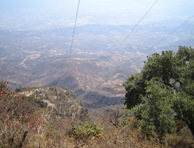 As we descended this last stretch, three things came into view. The first was a surprise: power lines, on high transmission towers, running straight up the mountainside from the valley floor. Beto explained that the Pinteros had had these brought up for the cabanas, which we’d visit later. The second was the tiny village of Pueblo Viejo, visible at last at the base of the range, seeming straight below.
  And the last of the three was a small tree, maybe 7 feet tall, on the passenger side of the road. A small pine in a familiar shape- the familiar shape of a piñon. It stood out on the hillside by the color of it’s needles- a soft, lighter green that the surrounding trees and shrubs, almost bluish. Beto rolled to a stop and I reached out through the open window and finally touched the Blue Piñon.
Several of the descriptions I’d read had mentioned the bluish color, but none had mentioned the feel of the needles. Light, soft and delicate, almost feathery, and completely unlike the stiff needles of the piñons I knew back home. The needles, bundled to their fascicles in sets of five, were two-and-a-half inches long, with a green surface and a lighter, almost blue, underside.
 We drove on another five minutes, blue piñons appearing left and right, increasing in height, until the road ended on a flat open clearing about fifty feet across. Beto smiled, and said, almost apologetically, “Now we have to walk.” I nearly laughed at his tone- I was dying to get out of the truck and stretch my legs. The clearing we’d parked in sat on a flattish bench that continued to along the side of the mountain to the North, and Beto led the way along a faint trail into the woodland that followed this bench. Almost immediately we were among larger, full-grown azules.
  As the woodland grew more sense, the dry grasses underfoot gave way to a bed of dead needles. Fallen cones were everywhere, and on closer inspection they weren’t fallen, but rather cut, left over form past seed harvests. Many of the trees held immature green cones, which were even more remarkable: three or four pounds in weight and a rich dark green color, they appeared a cross between a green pineapple and a hand grenade. We inspected several, and Beto showed me how to identify those that would have harvest-ready seeds the following season. Such cones bore a diamond-lattice pattern of faint brown lines highlighting where the scales would emerge and break open the following year.
 As we walked I picked up what appeared to be an extraordinarily large cone, thinking to keep it as a souvenir. I soon discarded it in favor of a larger one, which in turn I discarded for a yet larger cone moments later. Beto shook his head, “Leave it. I’ll find you a big one.”
 The tactile beauty of the needles extended even into death. Usually when sitting down on the floor of a pine forest, one has to seat oneself a bit gingerly to avoid an errant needle or two poking upward through the seat of the pants and stabbing one in the butt. But in a Martinez woodland- or rather in the Martinez woodland- the needles are so soft and light that one can carelessly sit or lie down almost anywhere free of underbrush.
 As I poked, picked, photographed and sniffed the bark on several large trees, Beto stepped off a few paces and fiddled with a bandage and a medicinal-looking bottle. When we rejoined a few minutes later I asked him if he was OK and learned the story of the armpit ailment- a spider bite. Type unidentified, but apparently nasty enough that Beto was taking the wound seriously and cleaning it regularly.
 For the next two hours Beto led me on a guided tour of the azules on his family’s property. We followed the faint winding path as a it contoured along the side of the range, maintaining for the most part a comfortably level grade. As we hiked, occasional breezes would brush the trees, and as the long needles were rocked by the wind they would appear to shift back and forth from bluish-green to traditional pine-green and back again, as the breeze exposed the underside of the needles.
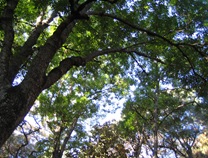 At one point the trail lead into a deep broad ravine with a small spring. The azules were absent from the heart of the ravine which was instead dominated by oaks reaching up more than 50 feet. The feel of this lush, humid grove seemed more northern California than anything I’d have associated with Southern Zacatecas. Leaving the ravine and re-entering the azules woodland, Beto stopped and picked up a whopper of a cone. “This is a big cone,” he said, and it was. I popped it into my pack.
 On our return hike back toward the chocolate, Beto asked me if I wanted to see the biggest azules on his family’s property. I eagerly agreed and we left the trail, scrambling up the steep hill. Beto’s footing was surer than mine, and while he easily hiked up the hillside, I slid a bit on the steep needle-covered slope, catching myself once or twice with my hands. Beto led up into a shallow ravine , in the center of which, growing out of the steep hillside, were half a dozen or so azules considerably bigger than any I’d seen previously.
  With trunks over 2 feet in diameter at the base, they jutted out of the hillside at an almost 45 degree angle for several feet before turning skyward. we sat down to rest on a giant bench-like root between 2 of them. At our feet were several cones, which we inspected, finding and shaking out a number of seeds. As I shook, picked and collected several dozen seeds, Beto cracked open seed after seed between 2 rocks, and together we sat in the shade of the giant azules, snacking on Martinez nuts. I realized happily at that moment that my quest was a success beyond my wildest hopes.
 One of the things I didn’t find mentioned in any of the writings I’d found on martinezii, and something that didn’t occur to me until much later was the issue of a dispersal agent. Martinezii seeds are far and away the most difficult edible pine nut to open.
  Later, at home in the U.S., I experimented on a number of smuggled nuts with several opening tools. Needle-nosed pliers, a sure bet with monophyla or edulis nuts, require 2 hands to crack the shell, and when they do, invariably destroy the nut. Vice grips crack the shell much more readily, but similarly pulverize the seed. A nutcracker? Not even close. I didn’t try teeth. A hammer on a cement step was the most effective method, but required practice and care.
 Most piñon seeds are spread by corvids, who as I mentioned earlier, value the nuts for food. But it seemed inconceivable to me that any scrub or piñon jay, or any other bird short of (possibly) a large raptor could generate the force to crack a Martinez shell. Maybe the simple reason why pinus maximartinezii grows on only one mountain is that no bird ever bothered to carry seeds to the next hill over? It’s possible that squirrels or some other ground-bound critter can crack the shell, and if so, such critters would be unlikely to shuttle seeds across the semi-desert valleys to the next range East or West, though one might reasonably expect the species to grow further northward along the range.
Ledig’s paper mentioned one other possible explanation for the strange genetic history of Pinus maximartinezii:
The possibility cannot be discounted that maxipiñon is a recent species. It is not difficult to imagine that agriculturists capable of breeding Maize from a weedy grass in a few thousand years could opportunistically select and propagate a large-seeded piñon. The Mayans apparently conserved and even introduced useful tree species into their walled selvas in the Yucatan, and elsewhere in Mexico, cherry, crabapple and leucaena were selectively promoted.
 The idea wasn’t expanded upon, or even mentioned further in the paper. (pic right = cones in tree.)Just three brief sentences, barely a whiff of an idea. But when I read it, the idea was of course immediately appealing, a vision of sophisticated ancient cultivators leaving behind a fantastic botanical legacy. And here on the mountain the idea was still more appealing, suggesting an explanation for many of the tree’s mysteries: the huge cones, the giant, super-nutritious nuts and the apparent lack of an effective dispersal agent coupled with its strange genetic history. Later, after I’d returned home, I emailed Ledig, asking if he or anyone else he knew of had explored the idea further. He replied:
“With regard to my speculation on incipient domestication of maxipinyon, I know of no follow-ups. DNA evidence might help, but the best evidence would be archeological. Ruins north of Cerro Pinones have been excavated, and I asked one of those involved in the digs about the presence of pinyon seeds or shells. The answer was that no one had looked, but my inquiry was, perhaps, too informal and not directed to the appropriate source.”
When I read this my thoughts returned to Cerro Las Ventanas, site of the not-yet-thoroughly-excavated ruins Miguel pointed out from his roof at dusk that first night in Juchipila. The Blue Piñon might yet have a story to tell.


![Human Eye Cones[4]](https://blogger.googleusercontent.com/img/b/R29vZ2xl/AVvXsEhgtCCY4rb9WUDVburk7_PuufAzTFGP4Nmaig2VzNMMnW0s3Z_hZCQtpHLS6XVxr3BvjNAsY1mh_6_fCP3cmZ9WhiSsCQLN0tUMaWjYtMLI7INIcVsAQ1J_uSaTFqYjV3cRiphmYyRMRUg/s1600-h/Human%20Eye%20Cones%5B4%5D%5B5%5D.jpg "Human Eye Cones[4]")


