Tuesday, April 21, 2009

Finally! Spring, Wildflowers And The Easter Bunny(s)

IMG_9175 Finally! This weekend really felt like Spring. Saturday was cool but sunny, a good day for a nice road ride. I headed up Emigration Canyon and on past the gate up Big Mountain Pass till the snow stopped me (pic below, right).

BMP Roadblock Tangent For Salt Lake Road Bikers: Seriously, is there anything nicer than a really smooth road that’s closed to cars? I know they need to open the road over Big Mountain Pass, but what about upper Mill Creek? Wouldn’t it be awesome if instead of opening it July 1, they just left the gate closed all summer? How cool would that be??

Sunday was even nicer- mid 60’s, sunny, and for the first time this season, I was able to ride the Bonneville Shoreline Trail from the zoo to City Creek. What a perfect Easter.

All About The Easter Bunny(s)

Tangent: Wait a minute, wasn’t Easter last weekend? Nope. Only for you heathens. Greek Easter was this past Sunday; Orthodox Easter is usually later than “American” Easter because they have the added date requirement that it fall after Passover.

When my siblings and I were kids, our parents of course wanted to celebrate Greek Easter, but didn’t want us to feel “different” or “left out.” So we had- get this- two Easters: “American Easter” and “Greek Easter”. This was of course way cool, but what was even cooler is that my parents developed a whole supporting Dual Easter Mythology, featuring- I am not making this up- two Easter Bunnies.

Nested Tangent: I’ve always been dismayed by the incredibly weak support-mythology for the Easter Bunny. Think about it. For Christmas, we have Santa Claus, and a whole supporting Santa-Mythology. We know where he lives (North Pole), we know what he does the rest of the year (make toys, keep lists.) We know how he does it (elves help him out) and how he delivers the toys (sleigh, flying reindeer, dropping down chimney.) We even know a bit about his family life (Mrs. Claus.)

easter-bunny-motorcycle But for the Easter Bunny, we got nothing. Who- or rather what- is this creature? Is it an actual rabbit? I always assumed it was more of a man-sized bipedal rabbit/humanoid, with prehensile forepaws (to, you know, carry the baskets) but if you think that through, that’s kind of scary. Where does the candy come from? How does he get to all the houses in the world in one night? And how does he get into your house? And is it a “he” or a “she”?*

*I always assumed the Easter Bunny was male, because even when I was a kid, I kind of sensed that obsessive loners who dedicate inordinate amounts of time to strange pursuits (famous artists, inventors, serial killers, the Unabomber, half-assed-stream-of-consciousness- science-bloggers) tend to be male.

ebunny president So let’s assume that the Easter Bunny was supposed to be a man-sized, bipedal rabbitish-humanoid. Where is he supposed to have come from? Is he a freak mutant rabbit, or just one member of a secret race of rabbit-men who burrow in the ground far below us? Or is he the result of some mad science experiment- an escapee from the Island of Dr. Moreau? Can he speak? And what about his clothes? A lot of drawings show him wearing a vest, like a fly-fisherman or a CNN reporter. But that’s all he’s wearing. He wears a vest but no pants? Great, now he’s a pervert, too.

Anyway you think it through, the Easter Bunny Story falls apart with even a moment’s critical thinking. After this blog, my next project will be to author a series of sickeningly-cutesy and ridiculously-overpriced children’s books that define and flesh out a comprehensive Easter Bunny Mythology.

American EB cut Yeah so like I was saying, we had 2 Easters with 2 different Bunnies. For American Easter, it was the “American Easter Bunny.” My sister- let’s call her “Elizabeth”- and I always imagined this bunny as- I am embarrassed to admit- white. We imagined the American Easter Bunny as happy, friendly, generous and uncritical.

Pap EB cut But on Greek Easter, the candy was delivered by- I swear I am not making this up- The Papadopoulos Bunny. Yes, that’s what our parents named him. Elizabeth and I imagined the Papadopoulos Bunny as dark brown, gruff, impatient and a bit cross; in short, pretty much like all the middle-aged Greek guys at our church.

Not EB Usually by late April I’ve been regularly riding Shoreline for ~a month, but this crazy, Stalker-Ex winter has made for a late start. So when I rode it Sunday, there was a lot to notice.

Right behind of the U. of Utah hospital is a good place to look around. This is one of the lowest and sunniest parts of the Shoreline trail and so whatever’s happening down here is a good indicator of what will be happening up a bit higher over the next couple of weeks. IMG_9153 Here’s the first Arrowleaf Balsamroot (pic left)I’ve seen this season*; in a couple weeks these things will be covering the hillsides above. Balsamroots, and their close cousins, Mules Ears, can be a bit confusing to distinguish. Last June I did a pretty thorough post on them that might be a good primer if you’re curious about them over the coming weeks.

*I checked last April’s archives. I spotted the first one of these last year on 4/23. These guys run like clockwork.

Shoreline Map 4 19 09 Also down low, in a couple of the minor draws, the Bigtooth Maples are starting to leaf out (pic right). IMG_9191Just a few hundred feet higher they’re still bare, but that’ll be changing within a week or so, and as I mentioned last year, the BT Maples generally leaf out a good week+ before the Scrub Oak, so over the next couple of weeks you’ll be able to tell the 2 trees apart pretty easily from a distance, which is a lot harder to do (from a distance) during the summer. As you do, you’ll see that the Maples dominate in the wetter, shadier draws, while the Oaks do better on the dry, sunny hillsides. (But over time, the Maples will begin to invade the Oak stands, a process which I described in this post.)

New Stream!

IMG_9190 In lower Dry Creek right now, the understory is practically carpeted with Glacier Lilies (pic left). If you’re local, try to ride/run/hike Dry Creek this week; it’s really stunning. Further up the canyon, pools of water appear, and before long (well below the South Fork junction) a full-on stream is running (pic right). IMG_9186 There’s always some water in Spring in the bottom of Dry Creek, but this is only the 3rd Spring in 14 years in which I’ve seen a full-on, cascading stream running down the canyon. Streamside rides are a fairly uncommon in Utah, and very unusual in the Wasatch foothills, so enjoy it while you can.

New Flower!

IMG_9165 You’ll leave the stream behind when you switchback left and climb out of the canyon bottom; for the next mile you climb till your first view of the downtown Slat Lake. The trail turns right/North here, and about ~50 yards ahead, on the uphill/East side of the trail, is a new blossom- Utah Milkvetch, Astragalus utahensis. This is another great-looking and distinctive flower. Unlike most wildflowers in the foothills, Milkvetch is irregular, in that there’s only one line along which you can divide it symmetrically. It’s a pretty flower, early to bloom, and does well in dry, cold, sunny conditions. IMG_9167 It’s a popular xeriscaping shrub, and does well once established, but is a bit finicky to get started. It’s very intolerant of shade, and supposedly extremely sensitive to being transplanted/repotted. (In addition, some gardeners claim the seeds are allelopathic*, and so should only be planted one to a pot, but other gardeners say this isn’t so.) The flowers will turn into woolly pods in a month or so, from which you can shake the seeds, if you’re inclined to try growing it.

*See this post for explanation of allelopathy.

IMG_9164 A. utahensis seeds can remain dormant-but-viable for several years, and have been the subject of studies around germination triggers. Following wildfires, land managers often try to reseed burnt areas with native species. But invasive species, such as Cheatgrass, are often much more aggressive in colonizing such spaces, in part because they germinate quickly and reliably. So land managers are always interested in figuring out how to get native shrub-seeds to germinate more quickly. The seeds of Utah Milkvetch for example seem to be triggered to germinate more quickly by the presence of a couple of different types of fungal spores.

There are over 2,000 different species of Astragalus. Some, like Utah Milkvetch, are pretty common (though this is the only spot I’ve seen it along Shoreline trail. The other place I’ve seen it is out on Stansbury Island.) But others are quite rare. An extreme case is Deseret* Milkvetch, Astragalus desereticus, down in Utah County.

*Name corrected following Sally's comment.

A desereticus Deseret Milkvetch has a way cool story. It was discovered in the 1890’s, and then last spotted in 1909. For over 70 years it was thought to be extinct, until a botanist re-discovered it in 1981. Its entire range consists of just 5,000 – 10,000 plants spread across 300 acres along a sandstone outcrop in Utah County, on a mix of private and state land. And the whole 300 acres- get this- is within 1,000 feet of US89.

Mystery Flower2 4 19 09 There’s one other foothill flower poking out right now, just starting to bloom. This flower (pic left) is all over the place in the foothills, and in fact it surrounds the patch of Milkvetch along Shoreline. It’s another exotic, Alyssum sp., possibly Pale Madwort, Alyssum alyssoides, which is native to Eurasia and a member of the Mustard family.

Of course speaking of flowers, down on the valley floor thousands of trees are practically exploding with blossoms right now, and though virtually none of these are native, they’re the brightest, loudest indicator of Spring, and worth checking out for a moment.

Next Up: Suburban Extreme Makeover

Note: Special Thank You to Lorraine aka “The Collector” for the Alyssum ID. Thanks Lorraine!

Friday, April 17, 2009

Bird Feeder Update + iRate iPhone iRant

IMG_9139 I have family in town this week, so between work and family-visiting type stuff I won’t have time for any more “serious science*” posts this week. (Pic right = Twin A after being kissed by multiple visiting female relatives.)

*I recognize that calling any of my posts “serious science” is a bit of a stretch; what I really mean is “posts for which I have to look stuff up.”

But so much is happening right now that I don’t want to skip another day, so forgive me for doing a fairly “lite”/observational post today.

This is a great time to be paying attention to the bird-feeder in your backyard, and here’s why: Let’s say you have a group of a few friends with whom you get together to do something every week. For me, that’s mountain biking on Tuesday nights in the summer, but for you maybe it’s getting together to go running or skiing or knitting, or watch “Law & Order” (Christ I hate that stupid show.) But whatever it is, it’s a habit, and you do it, but if something comes up to take you away from it one day/night/week it’s no big deal because you see all those friends every week.

Russ cropped But if an old friend you don’t see very often was passing through town and was going to join you on Tuesday night to bike/ run/ ski/ knit/watch a lame TV program, you’d probably make an extra effort to show up that Tuesday, because it’s so rare that you get to bike/run/ski/knit with that old friend. (Pic left = actual old friend I haven’t seen in 11 years for whom I would definitely change my plans to see if he were in town.)

That’s exactly how it is at your bird feeder right now. For months and months and months, the same half or so dozen birds show up at your feeder. But then, right around the end of March, new birds start showing up. And more new birds keep showing up over the next couple of month. But many of these new birds don’t stick around; they’ll hang out for a couple weeks or maybe just a couple of days, and then they move on.

What’s more, these new birds- as well as some of the old Winter birds- start singing! They’re singing in the morning, they’re singing in the evening, they’re chirping in the afternoon. In other words, there’s big party going on in your back yard right now, with a bunch of faces you haven’t seen in months, and will only be around for a couple days/weeks, so you better pop your head out back and make sure not to miss it.

Tangent: What? You don’t have a bird feeder? You’re not into birds? What are you, some kind of joyless robot? Live a little! Get a feeder! It’s the easiest wildlife-viewing experience you’ll ever know. Just hang a cheap feeder from a branch, fill it with a bunch of seed, and – voila!- you’re a regular Avian Marlin Perkins!

The Plot So Far

We’ve seen some cool newcomers over the last couple of weeks, but first I feel I need to catch up on what’s been happening at my feeder over the last 3 months, since I did the “Bird Feeder Week” series.

Pine Siskin with seed The biggest development was this- sometime in the last 90 days, when I wasn’t paying close attention, a pack* of Pine Siskins, Carduelis pinus, completely took over our primary feeder. These little guys, whom I initially mistook for female House Finches, are tough. They actively drive other birds away from the feeder, as well as each other, and there’s one member of the flock- the alpha-bird- who has zero tolerance for any other bird perching on the feeder at the same time (with one exception, which I’ll get to in a moment.)

*Yes, I know birds run in “flocks”, not “packs”, but these guys are so mean I call them a “pack.”

Speaking of Pine Siskins and House Finches, here’s an interesting difference between the 2: BHCB Back at the end of Bird Feeder Week, I blogged about the Brown-Headed Cowbird (BHCB) (pic left), which is a brood parasite, sneakily laying its eggs in the nests of other species, who end up raising the BHCB chicks. In that post I explained how the House Finch is such a lousy target for the BHCB; they lay their eggs in House Finch nests, but virtually none of the BHCB chicks survive, the reason being the lack of protein in the all-vegetarian diet fed by House Finches to their chicks.
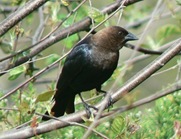
Well, unlike the House Finch, the Pine Siskin is an excellent and very productive target for the BHCB. Although Pine Siskins are primarily vegetarian, they add insects to their diet in Spring and Summer, and in particular they feed insects to their chicks. The seasonal protein boost is enough to support a BHCB chick, and Pine Siskin populations have suffered as a result.

Cowbird Siskin Diagram BHCBs and Pine Siskins have both been in North America a long time, but European settlement has brought them in closer regular contact. BHCBs are native to plains/grasslands, while Pine Siskins are native to forests. But both take readily to the to the semi-open woodlands created by modern settlement (think suburbs) and as a result the 2 species cross ranges much more extensively than in pre-settlement times, to the BHCB’s benefit and Pine Siskin’s detriment.

Siskin Towhee feeder shot Another bird that showed up back in February and has stuck around since is this guy, the Spotted Towhee, Pipilo maculatus (pic below, left). 4 cool things about this bird:

spotted_towheeFirst, it is way good looking. The feather-color pattern is cool enough, but the black head, back beak and orange eyes give it a way-cool look. Kind of like if a Robin went to a high-end salon and got a really killer makeover.

Second is its funky ground-hop. It spends a lot of its time on the ground under the feeder, scratching around for insects. And it does so with a 1-hop-forward, 2-hops-back gait over and over again.

Third is its toughness. When it does get up on the feeder, it is the one bird that won’t back down from the Alpha-Siskin. It doesn’t start fights, but when the Siskin goes after him, he comes right back at him, never backing off.

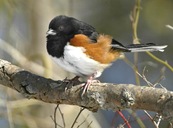
And fourth is the cool ongoing story of its sort-of-speciation from the closely-related Eastern Towhee, Pipilo erythrophthalmus (pic right). EasternTowhee1 The 2 species diverged sometime in the recent past, but are closely-related enough to easily interbreed. (In fact until about 15 years ago they were considered the same species.) Historically their ranges have been separated by the Great Plains. But Euromerican settlement has introduced large “forest islands” to the Plains (towns, suburbs), enabling the Eastern Towhee to expand its range westward, coming into contact with its Western cousin, and today the two frequently hybridize.
But here’s the cool thing about this story. Back in April – June of last year (way before anyone read this blog) I told this same exact story with 3 different bird-pairs: Stellers Jay/Blue Jay, Lazuli Bunting/Indigo Bunting, and Black-Headed Grosbeak/ Rose-Breasted Grosbeak. In each of these cases, an ongoing, partway-there speciation process is in the process of being possibly being altered or even derailed due to hybridizations made possible by human settlement, and alteration, of the Great Plains.

Towhee Meetup These aren’t textbook-theory-what-if scenarios; these are real, evolutionary processes and changes in action that have happened- and are continuing to happen- over just a few human generations. The more you get to know about birds in North America, it’s simply amazing the impact humans have had on them.

Tangent: There are actually ~9 species of Towhee in North America, and the details of their family tree have been the subject of much research and are still not entirely clear. But that’s a topic for another post.

house_sparrow_nigel_blake_470x365 Speaking of impact, another dramatic way people have changed the avian fauna of North America is through introductions, the 3 most obvious examples being the Rock Pigeon, the European Starling, and the European House Sparrow, Passer domesticus (pic left), the last of which has also started showing up more regularly to our feeder over the last 60 days.

Side Note: Though a recent arrival to our feeder, P. domesticus is a very common winter bird around the Salt Lake Valley, and in fact it is the dominant bird throughout the strip mall next to my office (the “Family Center” in Midvale.)

EH Sparrows were introduced in several separate East-coast events in the mid-1800’s. The motivation for the introductions was pest control, but the Sparrows themselves soon became the pests; they quickly expanded across the continent. They’re aggressive, and actively harass and evict other birds, such as Bluebirds and Purple Finches, from existing cavity-nests, smashing eggs and even killing adult birds in the process.

Tangent: From what I understand their introduction to Australia has been even more destructive; they’re a common pest in the Eastern half of the continent, and supposedly any EH Sparrow found in Western Australia is deliberately killed. I believe the original motivation for the Australian introduction(s) was also pest control.

Speaking of motivation, the European Starling wasn’t introduced* to North America until 1891, and the reason for the deliberate introduction was- get this- a group called the American Acclimization Society whose mission was to introduce to the New World all of the birds mentioned in the works of Shakespeare. I am not making this up. Talk about a bizarre hobby.

*Successfully introduced, that is. There were multiple earlier attempts.

Wait- What Am I Doing?

Wait a minute. This was supposed to be a “lite” post. But I’m already at 1400+ words, with graphics, tangents, a (sort-of) map and references to previous posts… What is wrong with me? Why can’t I do a short post? I see other people’s posts all the time, and they’re like:

“JP came over. We had a beer and saw some brown birds in the backyard. Then we ordered a pizza. Good times.”

And that’s like the whole post, and there’ll be like 20+ comments saying stuff like “Great post!” or “Sounds like you and JP killed it!” But no matter how hard I try, every one of my posts turns into some run-on-science-deep-ender. I swear, sometimes this blog reads like a cry for help…

While I’m on the topic of run-on posts, 2 readers- let’s call them “My Coworker Kelly” and “My Sister Elizabeth”- told me within the last week that they only read this blog for the tangents. They skip over all the science stuff and look for the colored sections where I go on about the Greek Church, or Phil’s lame bands or Ricardo Montalban. So before I go any further, I guess I’d better give them a tangent.

iRant

Tangent: I finally broke down and got a Blackberry this week. I resisted as long as possible, and then delayed the process a few more weeks by dithering between the Blackberry and the iPhone. I have colleagues with both, and checked them out, asked their opinions, and fooled around with each (device, not colleague.)

IMG_9151 I picked the Blackberry for a couple of reasons, partly for the keyboard, partly for the lower weight (remember, I bike with it) but most of all because I was so turned-off by the cult-like proselytism of the iPhone users. It’s like every new iPhone user feels this bizarre need to validate their purchase decision by turning into a virtual Apple sales rep. Whatever you’re talking to them about, they’re just waiting, waiting, waiting for an opening to whip out the iPhone. When you talk to them about something- a project, a trip, your weekend, whatever- they’re nodding along like “uh-huh, uh-huh…” but you can tell they’re not listening. No they’re just thinking, “Please, please let him ask me where the best place is in Indianapolis to get organic sushi so I can show him on my iPhone…”

iphone_large The most annoying feature they’re always demoing is the GPS. You go out to lunch, and they’ll say, “Let me just look it up on my iPhone…” and you’ll be like, That’s OK it’s down the street, it’s the same place we always go for fish tacos… but they’re already doing that bizarre origami-schtick with their fingers on the touch screen. Or you’ll tell them you’re running an errand, and they’ll ask where, and you’ll say, Oh it’s over on 700 East and 90th South, and they’ll be like “Let me just look it up on my iPhone for you…” and you’ll be like, No it’s OK, Salt Lake is on a grid, I can figure it out… Seriously the addressing system in Salt Lake- which is based on a very sensible numerical grid- is the easiest address system to navigate anywhere. If you can’t find your way around Salt Lake City without a GPS, you don’t need an iPhone- you need a Seeing-Eye Dog.

New Birds On The Block
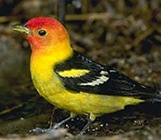
westerntanager OK, so that’s what happened at the feeder over the last 60 days. But now, over the last 2 weeks, new birds have started showing up- birds we haven’t seen since last year! Early last week a pair of Western Tanagers (pic left) appeared and spent an afternoon before moving on (blogged about them last year in this post) and on Sunday a male Red-Winged Blackbird, Agelaius phoeniceus, showed up for a day or so. RW Blackbirds are cool because they’re good looking and because they have the coolest call. You hear them all the time around in and around wetlands, but they’re unusual in our yard.

rwblackbird When you hear a male RW Blackbird calling, guess what it’s probably doing? Warning off other males. A. phoeniceus is highly polygynous, meaning one male breeds with many- up to 15- females, each of whom maintains a separate nest. The male jealously guards access to all his “wives” from other males, and it’s estimated that a male RW Blackbird spends roughly 50% of daylight hours warning/chasing off other males.

But what’s really interesting about this “harem-guarding” behavior is that it’s only partly effective; biologists have tested the paternity of A. phoeniceus chicks, and somewhere between ¼ and ½ of all chicks are fathered by other males, who successfully “sneak-mate” with the females.

The mating systems of different animals are always fascinating. And at a gut level, most human males- whether or not they admit it- certainly “get” the appeal of polygyny. But the more I learn about actual, real-world, polygynous mating systems, either animal or human, the more it sounds like a monumental pain in the ass. That reminds me: I need to pick up some flowers for Awesome Wife on the way home today.

Wednesday, April 15, 2009

The Amazing Elevator-Flower

About a month ago, I blogged about the first wildflower in the Wasatch foothills, Crane’s Bill. For the past couple of weeks, there’s been another little flower out, and unlike E. cicutarium, this one’s native.

IMG_9065 Yes, this is a geeky-botany post, but even if you’re not that into plants, if you mtn bike, hike or trail-run in the Wasatch foothills, this is a good flower to know because a) It’s all over the place, b) it’s easy to ID and c) it has an unusual & cool characteristic that’ll be interesting to watch over the next couple of months*.

*and d) you’ll totally impress your biking/hiking friends, who will think you are like Mr. Science. Or you might just drive them batty with all your geeky botany factoids, which is what I have long since done with all my biking friends. But even more annoying was back in 2001-2002 when I was learning Spanish and whatever they asked me during a ride I answered in Spanish. That totally drove them shithouse. Sometimes I wonder why I don’t have more friends…

IMG_9066 Despite all this, the flower, Long-Stalk Spring Parsley, Cymopterus longipes, isn’t in any of my wildflower guides (probably because it’s so diminutive that it’s easily overlooked) and because of this it remained a mystery for me until Sally – with the help of her friends “The Chemist” and “The Collector”- was kind enough to ID it for me.

Tangent: Sally, like me, often uses pseudonyms for friends she references in her (excellent) blog. I always get a kick out of Sally’s pseudonyms because they usually sound sort of like superhero-crimefighter names*. “The Chemist”, “The Collector”, and “Bee Lady” sound a bit like something out of an X-Men sequel, and when she mentions them in a post, I always get this mental image of a bunch of costumed characters discussing botany or entomology or whatever together for a bit, before jumping up and going off to fight crime.

*This is in stark contrast to the pseudonyms I select, which generally sound either like rappers (OC Rick, Clean Colin) or back-up singers for The Carpenters (Rainbow-Spirit-Paul, Aurora Coryalis.)

IMG_9087 Long-stalk Spring Parsley, and Spring Parsleys in general (genus = Cymopterus) are easy to overlook because they’re so tiny, but when you get down and check them out up close, you can see that they have a flower-head structure that’s similar to other flowers you’ve probably seen, such as Cow Parsnip or Queen Anne’s Lace. Like those flowers Spring Parsley is part of the Apiaceae family, which includes carrots, celery, and several of the items in your spice cabinet, including cumin, cilantro, dill and caraway.

All of these plants have flowers with what’s called compound umbel structure, which is sort of like a series of successive umbrellas, ending in a bunch of little florets. LS Spring Parsley is so small it’s hard to see the floral structure, but if you examine it closely enough, sure enough that’s how it’s set up.

Double Umbel Many Apiaceae plants are toxic. Last summer I blogged about the phytophotodermatitic sap of Cow Parsnip, but that’s kid’s stuff; the family also includes Water Hemlock (genus = Cicuta) which is quite possibly North America’s most toxic plant. The active poison in Water Hemlock is cicutoxin, which is actually an alcohol.

Geeky Chemistry Tangent: When we think of alcohol, we generally think of the stuff we drink. That’s actually ethanol*, which is a specific alcohol molecule, C2H5OH (diagram right). Ethanol But to chemists, “alcohol” is a broad class of molecules, all of which are characterized by having a hydroxyl group (which is just an oxygen atom paired with a hydrogen atom, or “-OH”. An oxygen atom always “wants” to make 2 electron bonds, so a hydroxyl group always “wants” to make 1 more…) bound to a carbon atom of an alkyl group, which is a grouping of carbon and hydrogen atoms in a structure that is a univalent radical, which is a fancy way of saying that it “wants” to make one more electron bond, making it a perfect match for a hydroxyl…

*Speaking of the alcohol we drink, check out the impressive, livin’-off-the-land Prickly-Pear Cocktail Sally whipped up last week. I swear, this lady would make Euell Gibbons proud. Or drunk.

circuta douglasii2 Cicutoxin, C17H22O2, is an alcohol you would never ever want to drink. It causes a swift and violent disruption of the entire central nervous system, leading to tremors, seizure and often death. Victims are rumored to have chewed their own tongues to shreds.

Cicuta_maculata_plant There are 4(?) species of Water Hemlock, 2 of which are found in Utah: Western Water Hemlock, C. douglasii (pic left), and Spotted Water Hemlock, C. maculata (pic right). Both have large, white, compound umbel flowers, usually stand between 2 and 5 feet high, and occur along watercourses. They look not unlike Cow Parsnip, but lack that species’ broad leaves, instead having pinnately-compound leaves, each with lots of little pointy leaflets.

Apiaceae includes many edible and medicinal plants, but due to problem-children like the various Cicutas, botanist-writer Thomas Elpel * says, “these plants are for experts only.” Most accidents happen when they are confused with wild parsnips (the two plants have similar, white tuberous roots.)

*And coming from Thomas, this is saying something. His excellent book, “Botany In A Day”, includes pointers to literally hundreds of wild edible and medicines- everything from wildflower roots to Engelmann Spruce seeds. I swear, this guy could make a 4-course dinner out of grass clippings…

So where was I? Right, LS Spring Parsley. Fortunately this thing’s so tiny there’s not much temptation to try eating it, but experiments feeding the seeds to baby chicks resulted in dramatically retarded growth and development, and even death in one case. The active compounds in this case are isoimperatorin (C16H14O4), and oxypeucedanin (C16H14O5), but I can’t find any evidence that these are harmful to humans in anything less than huge quantities, and in fact both are present in culinary Parsley.

IMG_9114 It’s not quite clear what pollinates these little flowers. Likely candidates include solitary bees (specifically Halictidae), syrphid flies (hoverflies) and muscid flies. (This last group is houseflies and stableflies, and includes the Common Housefly, Musca domestica.) Unfortunately I’ve been seeing these guys almost exclusively on pre-work AM rides, when the temps are sub-40F, and no insects of any kind are out and about yet. Maybe this weekend if the weather shapes up I’ll see if I can work in an afternoon ride with a ~20 minute stop-and-watch break by a clump, and see what shows up.

We’re Getting To The Cool Part

But none of that is the cool part about LS Spring Parsley. No, the cool part is how it grows, and how it will change over the next 60 days or so.

C. longipes leafs out and blooms in late March, and it does so lying flat, leaves splayed out along the ground. But as the Spring progresses, the entire plant- leaves, flowers and all- will gradually rise up off the ground as a single unit, almost like it’s on a slow-motion elevator, until it reaches a height of up to 10 cm off the ground.

Pseudoscape Diagram As the Spring progresses, the ground gets warmer and warmer during the day. By the end of this month or early May, the daytime soil temps on South-facing hillsides around here will be well above the optimal photosynthetic temperature for the plant, resulting in decreased photosynthesis and less-efficient water usage. So the plant gradually raise up off the ground to optimize photosynthetic temperature. An in fact this “uplift” will be more noticeable with C. longipes on sunny, South-facing slopes, than for those in shadier, less-exposed spots.

Here It Comes…

But wait, wait! That’s still not the cool part- I’m still just setting up background and building the suspense! No, the cool part about the gradual Spring ascent of C. longipes is how it does it. It grows an anatomically unusual feature called a pseudoscape, or “false stem”.

Pseudoscape2 A true stem grows up and branches into various new growths- flowers, branches, leaves, cones, etc. A false stem doesn’t do this. Instead, the section of tissue between the ground and the existing leaf/stem/flower structure begins to grow and extend, lifting up the entire, already-developed leaf/stem/flower structure. So unlike a “normal” plant, where a stem pops up and then grows and branches into an “adult” plant structure, LS Spring Parsley does just the opposite: The adult plant grows and blooms on the ground, then the pseudoscape starts growing, raising the structure up to optimal height.

Side Note: Other Cymopterus species also grow pseudoscpaes, but none so pronounced or well-developed as C. longipes.

Pseudoscape1 Of course over the next couple of months all kinds of crazy things will be growing and blooming, and LS Spring Parsley will tend to get lost/buried in the grass & shrub jungle of the Springtime foothills. So try to make a point, while things are still largely low and mellow, of noting a clump of the plant now while it’s easy to spot (preferably in a sunny location), along some trail you’ll bike, run or hike often as the season progresses, and then make a mental note to keep an eye on it in the coming weeks and watch what happens.

I’d like LS Spring Parsley even if I didn’t know a thing about it, if just for that long-awaited first spot of color it provides. But I also like it because it’s a great little showcase that almost any little plant, once you check it out and learn a little bit about it, has got some cool story to tell.

Tuesday, April 14, 2009

Catch Up: a Flower, a Blog and a Hole

Change of plans. I’m going to do the post I alluded to on that cool foothills flower tomorrow, and use today’s post to catch up on a few other things.

A Flower

IMG_9121 First, right after I did yesterday’s post, mentioning that Glacier Lilies should be coming up “any day now”, I thought “they’re probably already up.” Sure enough I hopped on my bike and pedaled over to the mouth of Dry Creek, and they’re all over the place. It’s such a pretty flower, so easy to ID, and recognize all the parts. If you live along the Wasatch, even if you’re not really into plants, you owe it to yourself to keep an eye out for these guys over the next couple weeks, and stop at least once to check one out close up. IMG_9122(If you want to know more about Glacier Lilies, check out the post I did on them last year.)

Seriously, how can you not be totally smitten by a flower this good-looking? Let’s have another shot.

A Blog

Second, it’s been a while since I updated my blogroll, and I’ve added an awesome blog today. Beetles in the Bush is the blog of Ted MacRae, a Missouri entomologist. cropped-ted-and-celeripes-loc1081red Ted’s blog has of course, many great posts about invertebrates, and specifically beetles, but he doesn’t limit himself to just insects. He also posts regularly on botany and other topics, and his recent Lake Tahoe Conifer series is outstanding. (Seriously, before your next trip to Tahoe, check out those 2 posts.) He also- like me- enjoys blogging about things encounters away from home, and both the Tahoe series and Sunday’s post on the Coral Pink Sand Dunes Tiger Beetle (yet another reason for me to get back down there) are great examples.

Ted’s also been a welcome, constructive and extremely helpful commenter on this blog over the few weeks since we’ve found each other, and I’m exceedingly grateful for his time and patience in a repeatedly helping out a total Bug-Newbie*.

*Me.

Finally, I should mention that Ted is also an avid cyclist, confirming that we are in fact, kindred spirits. Go check out his blog, and keep an eye on it through the year; you’ll be smarter for it.

Side Note: Big thank-you to reader Tomodactylus for clueing me in to Ted’s blog. It’s hard to aware of all the fine science/nature blogs out there, and I really appreciate readers letting me know of great ones.

A Hole

The last catch-up item is rather less cheerful; it’s a hole. Yet another hole, that is.

One of the great things about living on the edge of urban/suburban development (I live about ~1/2 mile from singletrack) is the wonderfully easy access to open spaces. But that easy access has a dark side: the open spaces you frequent most are often those most threatened by development.

BST UNHM Map I’ve been living along the Wasatch for nearly 14 years, and with the exception of a 3-year “break” down in Holladay, have spent all of those years living on the East side of Salt Lake City. During those years I’ve married, had 3 kids, and a series of busy jobs. My schedule over those years has meant that a huge portion of my time outdoors has been in the form of early morning/early evening mtb rides along the foothills between Emigration Canyon and the Ensign Peak radio towers. Every time another chunk of land along that stretch gets torn up for a new building, it feels like an old friend has up and moved away.

Sat Zoom UNHM cut One of the least attractive was ~5-6 years back, when the NPS Pharmaceuticals building went up along Colorow Way. NPS has since gone under, but its taste-free box-like architecture still stands strong. The NPS building took out a short but wonderful little trail we used to call “Rikki Tikki Tavi.” RTT was a short connector trail between Shoreline and Colorow Way, and it twisted tightly through a beautiful little Scrub Oak woodland. It was flat and non-technical, but twisted so much, through trees so tightly-spaced, that you always felt wonderful when you cleaned it. (It featured a gap between 2 oaks that absolutely could not be passed with a handlebar wider than 24”.) It was also a charming little walking trail for small children, a quick escape into a “secret” little forest.

IMG_9067This past year, the lot immediately Northeast of the NPS got taken out, for the new Utah Museum of Natural History. The construction has obliterated and blocked a 100+ yard stretch of the Shoreline Trail, necessitating an awkward and often traffic-clogged detour to continue Northward toward Dry Creek. This stretch of trail is/was probably the most popular, well-used piece of dirt in Utah, with bikers, hikers, runners, families, dogs, even landing paragliders.

The irony of this location is that it so negatively impacts exactly the type of people who are most likely to patronize a natural history museum. If you’ve been reading this blog for a while, you can probably well imagine how much I enjoy visiting such museums, and that is indeed the case. Taking the Trifecta over to the existing museum on the U. of Utah campus has been a regular Watcher-family-rainy-day activity for several years now; we’re close to “regulars.” I’ll be torn taking them to the new museum; I’m sure it’ll be a nice facility, and I won’t deny my kids the experience out of pique, but I know the building will always rub me the wrong way.

Side Note: To a certain extent, I blame myself. My active resistance was both too late and too little, consisting of a letter to the paper, and signing various emailed petitions. If ever there was a good reason for me to lie down in front a bulldozer (a la Hitchhiker’s Guide to the Galaxy) the new museum was it.

IMG_9117 Yesterday morning, as part of the bad-karma-detour around the worksite, I pedaled up the access road to the Red Butte Garden lot. Instead of turning left on Shoreline I continued another 20 feet uphill and rode into the lot. For years I’ve made a slight side-trip here to catch a fun little 30-foot-long feeder trail that drops from the lot through some tight Oaks back onto the main trail. But at the end of the lot, this is what greeted me- another new pile of dirt, obliterating the trailhead, for some new, as-yet unknown- construction project in the Garden.

Tangent: In fairness, I should acknowledge some of the many fine trail developments in Salt Lake Country during my time here. Surely the construction of the Shoreline Trail between Dry Creek and City Creek has been one of the county’s smartest moves ever.

Nested Tangent: Although if like me, you’ve been around long enough to remember the pre-Shoreline Dry Creek ride, you may share the same reminiscent twang I sometimes do when recalling the technical singletrack and rock gardens that preceded it, and the thrill of cleaning the oh-so-dicey ascent for the first time…

And the City of Draper has done a fine job showcasing the natural beauty of much of Traverse Ridge with the fine hiker-biker trail network they’ve constructed over the last few years. And then of course the trails and open spaces of Summit County offer an admirable compromise between continued development and preservation of accessible open space but then Summit County has always seemed a bit more “Colorado” than “Utah”, which brings me to…

As longtime readers may recall, I lived in Colorado for 5 years before moving to Utah. I know that comparing current/past places you’ve lived is a little like comparing current/past spouses (or girlfriends/boyfriends, for you “oncers” out there.) It’s tempting and oh-so-easy to do, but in the long run, it’s probably generally best to refrain from doing so; making comparisons doesn’t change past homes or loves, and it’s best to look forward.

And to be sure, when I do succumb to the temptation of comparison. Utah wins handily. The smaller size, quick metro-to-canyon access, finer skiing, mild traffic, low cost-of-living, close-in airport and easy access to desert make it a better home for me*.

*OK so yes, now I am doing exactly what I just told you not to do in the preceding paragraph. I swear, I should rename this blog www.allmybadadvice.blogspot.com

But when I think of open spaces, and specifically support for and attitudes around them, Colorado is the clear winner. The counties of the Front Range have long made progressive decisions, actions and investments to protect key parcels of open space throughout the foothills. My former home, Jefferson County, was a wonderful example. They had (still have, I think) a 1% sales tax dedicated solely to acquiring (and to some degree, protecting and/or developing) open space.

GFox Map Behind my old house in Evergreen, Berrian Mountain was one such undeveloped example, and a point I scrambled up at least a couple of times a year when I lived there. Nowadays, a couple of times a year I sneak a peak via the satellite photos on Google Maps. It’s still there, green, forested and unbroken: a lovely refuge, protected from roads, or houses, or even museums.

OK, new flower tomorrow. Really.