Ah, another great summer weekend. Racing, wildflowers, pool-time with the Trifecta and margaritas with the neighbors. Summertime does not suck. Lots to blog about, so let’s get rolling.
 Sunday morning I did a nice, mellow Mill Creek mtn bike ride with OCRick. I hadn’t ridden with OCRick in a couple of weeks and we were both in the mood for something easy. Usually OCRick has zero tolerance for my stopping-and-checking-out wildflowers/moss/lichens/shrubs hijinx, but yesterday he was not only indulgent, but even encouraging, of my frequent stops. I attribute this to 2 reasons.
 First, OCRick has finally figured out that frequent photo-geek stops have the side-effect of moderating my pace. I tend to be a fast climber on a bike, which sometimes means I set a faster pace than some of my friends- OCRick included- are entirely comfortable with. After 13 years of riding together, he’s finally figured out that encouraging my stops slows the overall climbing pace of a ride*.
*In marked contrast to UTRider, who figured out the same approximately 20 minutes into our 1st ride together, and cunningly loaned me his camera- as a substitute for the one I’d just dropped on the road- for the remainder of the ride.
 But the other reason was that we were both beat. OCRick had just returned from a week+ combination mtn/road biking trip in Colorado and…
 Tangent: OCRick (pic right), who did this trip while recuperating from recent knee surgery, managed to crash in Carbondale and received about a dozen stitches in his arm as a result. And this brings up probably the most remarkable thing about him*: out of all my circle of friends, OCRick has been to the emergency room at least 5 times as often as any of the rest of us. At age 63, his extremities are festooned with scars and held together with the help of several pins.
*Other than never reading my blog.
First Thing About Me
…and I was trashed from Saturday’s race, which brings me to the first- and only one of which I am proud- thing about me in this post. Over the last 2 weeks I mentioned my recent racing-category-upgrade to Cat3, and my ensuing self-doubts concerning both my ability and sanity in doing so. Saturday was my first Cat3 race, the Porcupine Hill Climb up Big Cottonwood Canyon, and I’m pleased to report that I did not embarrass myself: I placed 4th.
Tangent: Because when you get right down to it, for us 99.99% of bike racers who never get anywhere near being pro, there’s really only one thing that matters- Not Embarrassing Yourself. That’s it. That’s all we really care about. Guys will tell you they like the camaraderie, they like being part of a team, they like challenging themselves, and maybe some of that stuff is at play too, but mainly we just don’t want to embarrass ourselves.
This leads me to ponder on the bizarre nature of hill climb-races. In a hill-climb, you just go up. That’s the whole thing; there’s a minimum of strategy or skill required. The experience is a little over an hour of pure suffering. This was my second year doing the Porcupine Hill Climb, and both years, around Silver Fork Lodge, I thought, “This is awful. I am so hating this. Why did I pay $40 to suffer like this?” But then you finish and everyone’s telling each other what a great job they did, and within an hour you forget how much you hated it and are already thinking about next year’s race. Why is that? Why does my memory suck so badly? Oh wait- I’m going to get to that in the second thing about me…
 So anyway, back to the ride. The upper Mill Creek flowers right now are fantastic. Even if you know absolutely nothing about flowers, you can’t helped but be blown away up there right now. The trails are lined with touches of almost every color- white, blue, purple, yellow, red, pink- and every open meadow is just an explosion of color. It just doesn’t get any better than right now.
 Many of the flowers blooming up there are flowers we’ve looked at already- Columbine, Wild Rose, Thimbleberry, Scarlet Gilia, Utah Sweet Pea, Chokecherry, Ninebark, Small-Flowered Stickseed, Indian Paintbrush, Sticky Geranium, Richardson’s Geranium, Showy Penstemon, Mountain Bluebells, Western Larkspur, various Arnicas, and so much more. But what’s really cool about riding in the Wasatch right now is that after almost 16 months at this project I can ride a trail I’ve ridden probably a hundred times and still pick out new wildflowers. In this post I’ll highlight 5 great ones I either hadn’t seen, or hadn’t ID’d before today.
Flower Number One
 First up is one I’ve been looking for for a long time- Orange Mountain Dandelion, Agoseris aurantica (pic left.) It’s closely related to the “standard” Mountain Dandelion, A. glauca, which we looked at back on May in Round Valley, and in fact the 2 species sometimes hybridize. I’ve seen this guy in every flower guide I own, but never spotted it till yesterday, trailside up at the meadow on the saddle between Mill Creek and the Canyons at about 8,500 feet. This one is a stunner- it just might beat out Blue Sailor for my all-time favorite composite.

 By the way, an interesting little anatomical thing (besides their ray-only flowers and calyx-parachutes which I explained last year when I blogged about “regular” Dandelions) about both orange and yellow Mountain Dandelions is that their “stems” aren’t really stems. They’re peduncles, which is technically the connecting stalk between the base of a plant and its flowers
Second Thing About Me
So many composites are yellow, one that’s not is really eye-catching. If you don’t pay close attention, yellow composites can start to run together. And that brings me to the 2nd thing about me of this post, of which I’m considerably less proud, as it suggests that I’m inattentive, gradually senescing, or possibly even a little bit racist. But here goes: little blonde-haired children are all starting to look the same to me.
Twin B has 4 friends in the neighborhood. All are little girls, 7 or 8 years old, with blue eyes and shoulder-length blonde hair. And I’m starting to get them mixed up. It’s to the point now where I deliberately avoid using first names (“Hey there!” “Hi kiddo!”) because I’m afraid of making a mistake. Of course this could be attributable to my previously-blogged-about dismally low Dunbar number, but I sometimes wonder if there’s some strange sub-conscious race-recognition/categorization thing going on.
I grew up in a place where blonde kids were fairly rare. Oh sure there were blonde kids around, but they were maybe like 1 out of every 10 or 15. But here in Utah it seems like 4 out of 5 little kids are blonde. And because I didn’t grow up around so many blonde people, well, sometimes, when I’m tired, or had a couple of drinks, they all look the same to me. Is it racist or something to admit that? Oh boy, I feel terrible just writing it. I probably just lost a bunch of (probably blonde) readers. Well, all I can say is, it probably didn’t freak you out as much as the next/third revelation of this post will, which is a Total Blasphemous Shocker.
Flower Number Two
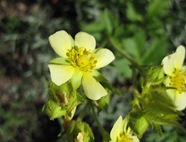 The second flower is considerably less spectacular, but one I’ve pedaled by countless times before finally knuckling down and IDing yesterday: Large-Leaf Aven, Geum macrophyllum (pic left). It’s all over the place between 6,000 and 7,500 feet, low to the ground and easy to ignore. It’s not spectacular but it’s so common that it falls into the I-really-need-to-know-what-this-is category. This little guy has an impressive range; it occurs all over Western North America, from Alaska to Mexico, and it’s yet another member of the fabulous Rose family.
  It belongs to that first subfamily I blogged about in the monster-long Rosaceae post I did last week, and so is more closely-related to things like Wild Rose, Raspberries or Thimbleberry than it is to say Serviceberry or Chokecherry. A good clue for this guy is its distinctive leaves (pic right).
Side note: “Aven” is a tricky name. It’s most often used for plants like this guy, which is part of the Geum genus. But it’s also used for plants like Mountain Aven or Drummond’s Aven, which belong to the genus Dryas, and are part of a completely different subfamily of Rosaceae, specifically the Cliffrose-Mountain Mahogany group.
Flower Number Three
 The third flower is also yellow, but it’s a total looker: Common Yellow Monkeyflower, Mimulus gutattus (pic left). Like Penstemon (and Toadflax), Mimulus is part of the Snapdragon family, and the flowers are obviously similar in form. But in Monkeyflowers, the “face” is the showiest part, whereas the “tube” of a Penstemon flower is considerably longer than the “face” is broad. There are about 20 species of Monkeyflower in the Intermountain West, more than half of which are yellow. And there are all sorts of varieties of M. Gutattus, so this group can be a bit confusing. But there are at least 2 cool things about this flower. First, all Monkeyflowers have hinged stigmas at the ends of their styles. If anything touches it, it closes. But- and here’s the cool part- if it closes on anything other than pollen from the same species of Monkeyflower, it re-opens in a few minutes! Even cooler, it will re-open if it closes on its own pollen, meaning from the same plant, whether the same or another flower!
Side Note: Supposedly this is easy to see later in the summer, as the petals and stamens fall away, leaving the style exposed. I’ll be on the look-out for it.
The second cool thing is that over the last 60 years, Mimulus has been one of the most intensely studied plant genera. It includes tremendous variation, with different species adapted to deserts, mountains and even aquatic environments. It includes both annuals and perennials, herbaceous forbs and woody shrubs, diploids and polyploids, and best of all, it has a small genome, making it well-suited for genetic study. Anyway, even if you don’t care about that stuff, it’s got those cool red dots inside its “throat.”
Flower Number Four
 Three down, two to go. This next guy is another in the category of “small, unspectacular, but I see it all over the place, so should get my act together and ID it." It has a cool name: Leafy Jacob’s Ladder, Polemonium foliosissimum (pic right). It’s a perennial, so you’ll see it in the same spots from year-to-year. Polemonium includes about 25 species and is part of Polemoniaceae, the Phlox family, and the various phloxes we saw early in the season in the foothills are the things we’ve looked at most closely-related to it.
Now here’s the interesting thing about Leafy Jacob’s Ladder: If you live in Colorado or New Mexico, or other stretches of the Rockies, you may be saying to your self, “Hey wait a minute- Jacob’s Ladder is blue!” And mostly it is. But here in Northern Utah, almost all of our P. foliosissimum is of the subspecies var. alpinum, in which the flowers are white. So if you fall out of an airplane in the night in July between San Francisco and St. Louis, and wake up* in a Mountain meadow and want to figure out if you’re in Utah or Colorado, check out the color of these flowers.
*OK I grant that it would be extremely unlikely that you would in fact, “wake up.” But it is possible. This, right here, is my absolute favorite falling-out-of-a-plane story. Seriously, how amazing is this?
Third Thing About Me – The Shocker
OK, I saved the best flower for last. But first, I need to deliver on my aforementioned third, shockingly blasphemous self-revelation. I hesitate to share this, knowing that a good portion of my readers are cyclists, and fearful that this will alienate me from them forever, but I just have to come clean. I can’t keep living a lie. Here we go:
I don’t watch the Tour de France.
That’s right. I- an avid cyclist, epic mountain biker and Cat3 road racer- do not watch the Tour de France. I don’t know what stage it is* or who’s wearing what jersey now or who’s shooting up what. Of course I admire the racers and the event and tradition and all, but I’m just not that interested in watching. Here’s the deal: I am the World’s Worst Sports Spectator. I don’t watch the Superbowl, the World Series, the NBA Playoffs** or the US Open. I’m just not interested. Part of it is probably that I come from a total non-sports-watching family, but I think an even greater factor is that I am fundamentally and inordinately self-involved; if I’m not playing, I don’t care who wins. You know, there’s 2 good tangents here:
*I think it’s either Alpes d’Huez or Omelette du Fromage…
**It’s the “Playoffs” in basketball, right? Or is there some other big event I’m missing?
Tangent #1: One of the absolutely weirdest things about me is that I am at all athletic. The rest of my birth-family is like an advertisement for poor fitness and lack of coordination. My Mom (who was and is pretty much the Best Mother Ever) always dutifully asks me about my races. She’ll ask how I did, and then ask the distance. And here’s the great part- whatever distance I tell her, say 80 miles, she’ll scream “Oh My God!” as I if I just told her I had paddled a canoe across the Pacific or derived a Unified Field Theory. The idea that someone could pedal- much less race- a distance on a bicycle that would take longer than 15 minutes to drive in an automobile is utterly incomprehensible to her.
Tangent #2: OK, so you think I’m a whack-job because I don’t watch the TdF. But can we at least agree that sports fandom often borders on complete lunacy? Here in Utah, the most bizarre rivalry is the football rivalry between the U. of Utah and BYU. Grown men- even old men- get phenomenally amped up about these games and their outcomes, which of course involve… a bunch of 20 year old kids throwing an oblong ball around. The fans profess to hate the other school and all it stands for, as if they were Jews and Arabs fighting over the Golan Heights. Which is odd because both schools are largely composed of… white, mainly Mormon, kids from Utah.
This wacky fandom extends to the Tour. All kinds of people tell me how they record and watch the Tour nightly, which is all well and good, except that many of these people- who react incredulously when I confess I don’t watch it- are people who pretty much never ride their bikes. They’re like, ‘What? You’re not watching the Tour??”” And I’m like, “Well I’ve been busy doing stuff- like actually riding my bicycle.”
Phew, good to get that off my chest. Well, if there’s a still a reader left who hasn’t clicked away in revulsion or disgust, I’ve got a great flower for you. Check this out:
Flower Number Five
 It’s Case’s Fitweed, Corydalis caseana, ( pic right) and it’s a member of the Poppy Family, Papaveraceae (and in fact I think it’s the first member of this family I’ve blogged about since the rare Bearclaw Poppy, which we saw last Spring down in St. George.) Its flowers are unlike any others, with 2 white outer petals flaring out at the top, and 2 reddish-purplish petals nestled inside, joined at the tips. This species is pretty rare in the Wasatch- and in Utah in general, and occurs most often streamside in PLT forests between 7,000 and 9,000 feet, which is exactly where you can find it in Upper Mill Creek Canyon (see map above), along the Great Western Trail (pic below, left).
 It’s called “Fitweed” because of its effects on sheep and cattle. Although they find the foliage tasty, the plant contains the alkaloid Bulbocapnine (diagram below, right), which is toxic to livestock. Late in the summer the fertilized flowers will transform into inch-long seedpods, which will burst explosively to scatter their seeds.
 There were at least 3 other new flowers up there I could’ve blogged about, but well, you need to stop reading now and start composing your TdF-related hate-mail. But I am telling you, this week is spectacular up there. Make sure to check it out.


