Showing posts with label moss. Show all posts

Friday, March 27, 2009

Costa Rica Part 4: All About Cloud Forests

IMG_8694Strangler Figs are all over the place down in the lowland rainforests, but they’re even more obvious and more fantastic (pic right) up in the cloud forests, where we spent the last 3 days of the trip. IMG_8886Tropical Cloud forests form atop mountain ridges above 1500m which are almost always enveloped in clouds (pic left), and so receive nearly all of their moisture as mist. IMG_8780They’re sort of like a cool-to-chilly rainforest, expect that the epiphytes have gone utterly berserk. Everywhere you look, on every tree (pic right- take a sec and click on it. Look at all the stuff growing on that one tree. Is that insane or what?), are mosses, lichens, bromeliads, orchids, heliconias growing all over everything (even wooden park benches are mostly moss-covered.) The interior of a cloud forest is generally damp, misty and dim. But on a (rare) sunny day, a cloud forest is, hands-down, the most beautiful place I’ve visited on the entire planet.

IMG_8808 Of the 3 days we spent in the cloud forest, 2 were bright and sunny. To be surrounded by light and beauty that intense for the better part of 48 hours is almost a bit of sensory overload. When you get back down to the pastures of the lowlands (or worse yet, Northern Utah in March) it’s almost as though the cones of your retinas have been burned out; nothing seems to have any color for a few days.

IMG_8626Speaking of another way of being a tree, another first for me were the fabulous tree ferns, which grow up to nearly 20 feet all over the place in Monteverde. Ferns are ancient and fascinating plants. IMG_8635They’re true plants, with a vascular system and true real leaves, but they’re not seed plants, instead reproducing via the alternating gametophyte-sporophyte generational strategy we saw when we looked at mosses. So every Fern you see is chromosomally haploid, like a sex cell (sperm or ovum) in a human.This guy is Sphaeroptyrus brunei, or Monkey Tail Tree Fern, so named because its uncurled proto-fronds look like monkey tails.

Filmy Fern Besides the tree ferns, there are both “shrubby” ferns and epiphytic ferns growing all over the place. Check out this one- it’s called Filmy Fern, one of the 37 species of the genus Hymenophyllum found in CR. Is that alien-looking or what?

IMG_8664 Another first for me- and a long-awaited one- were Clubmosses and Spikemosses, which are Lycophytes (pic left). On the complexity spectrum, Lycophytes sit between Mosses (bryophytes) and Ferns; they have a true vascular system, but not true leaves, and reproduce via the same alternating-generational strategy as Mosses and Ferns.

Why You Should Care About Ferns and Lycophytes

IMG_8750 Even if you’re not a plant-nut, there are at least 2 reasons worth knowing about Ferns and Lycophytes. First, the very first forests, long before there were angiosperms or conifers or ginkgos or even cycads, were composed of Ferns and Lycophytes. Tree Ferns I just mentioned; back in the Carboniferous period, Tree Ferns existed that dwarfed anything we saw last week. But even more interesting, there used to be Lycophyte trees (diagram left.) Lepidodendron1These ancient trees, belonging to the long-extinct genus Lepidodendron, together with Tree Ferns dominated the planet for around 50 million years before seed plants showed up and eventually evolved into trees. Lepidodendrons of all species had a simple, distinctive form- a straight trunk that branched into a “Y”. Think about that; for 50 million years, there were pretty much just 2 tree shapes in all the forests of the world- Tree Fern, and “Y”-shaped.

Tangent: It’s simply amazing to me that the only living relics of the mighty Lepidodendrons, which dominated the planet so thoroughly, for so long, are little moss-like things. Really makes you think about evolution, and how things turn out in the long run…

IMG_8641 The second reason is more practical: the gasoline that powers your car, the natural gas that heats your home, the diesel fuel that powers the truck that carries the fresh avocados to your neighborhood Albertson’s, and the coal that powers the turbines that produce the electric current that runs the PC you’re reading this on,- all of those and virtually every other petroleum product that powers our modern world- were produced by those ancient Lepidodendron/Tree Fern Forests. Coal and petroleum deposits are the final end-products of 300 million year-old forests. Our entire civilization is powered by Ferns and Lycophytes.

Flowers!

Goldfish1 The rich green light of the Cloud Forest is accented with countless flowers of all different colors. Orchids, Pavón de Montaña, Goldfish plants (pic right), there are too many wonderful flowers to cover in just one post, so I’ll zoom in on one – Heliconias. These beauties, which occur all over the country, both in the cloud forest as well as in the lowlands below, are striking in both form and color. HeliconiaAt first glance, they appear much like a Bird-Of-Paradise–type flower. But there’s a clear difference: Birds-Of-Paradise are brightly-colored flowers sitting in a green, pointy-cup-like bract. Heliconias are dullish-green flowers sitting in a brightly colored pointy-cup-like bract. With the former, the flower itself attracts the pollinator; with the latter it’s the color of the bract which first catches a Hummingbird’s eye. This one (pic left) is Heliconia monteverdensis, which occurs mainly up in the cloud forests, but you’ll see Heliconias all over the country.

IMG_8753 In a land so foreign and a forest so strange, it’s somehow comforting to latch onto something familiar. For me, a constant in my travels has been Oaks. From the foothills of the Wasatch, to the rolling hillsides of California, from Hyde Park in London to Zacatecas Mexico to the hardwood forests of New England, I’ve long enjoyed seeing and recognizing Oaks of all different types. And even here, in this bizarre forest in the clouds, I found one- this wonderful, massive, ancient oak, Quercus costaricensis. (pic right)

Another constant for me in my travels of course has been pines (of which last week’s Blue Piñon was one example.) And though you’ll often see Pines along the roadside in Costa Rica, they’re not native. The most commonly planted Pine is Pinus ocarpa, a 5-needled Pine which occurs natively as far South and close by as Nicaragua. But South of the Nico-Tico border, the range of Pines ends, and where conifers occur again they’re Araucarias or Podocarps. (For a description of Podocarps, see the last paragraph of this post.)

Podocarps make it up into Central America clear into Southern Mexico, and having never seen one in the wild, I had half an eye toward spotting on on this trip, but didn’t think any were common in the areas we’d be visiting.

IMG_8837On Friday afternoon, after hiking in the Santa Elena cloud forest, we returned to kick back around the hotel for a few hours. While Awesome Wife and the Trifecta relaxed, I took the car out to look for another trailhead, and a quick pre-dinner hike. As I drove up a dirt road looking for the trail, I passed a lithe, brown-haired, middle-aged gringa walking up the road. She looked somehow familiar… from a book…

I hit the brakes, backed the car up and rolled down the window. “Excuse me,” I asked, “Are you Willow Zuchowski?” And in fact it was her, the guidebook author herself, a bright, charming woman with whom I spent the next 15 minutes chatting about her wonderful book and trees of the area. Toward the end of our chat, I asked her about Podocarps, and she told me that they did in fact grow in Monteverde, and where to find them.

Tangent: I actually have several stories about running into (and recognizing) guidebook authors. My favorite was about 3 years or so ago, when I rescued Steve Allen from a sand-trap in which his van was stuck in the San Rafael Swell.

IMG_8858The following morning, the day we had to drive back to San Jose, I rose before dawn, padded quietly out of the cabina so as not to disturb my sleeping family, and drove back to the Monteverde park entrance. At park opening, 7AM, I was the first visitor to enter the park. Unlike the previous 2 days, it was a “typical” day, enveloped in cloud-mist, dim and mysterious. For the next 3 hours I hiked alone, passing just 4 other hikers, 2 of them rangers. I finally arrived at the landmark and junction from where Willow told me to look, but whether due to the thick mist, or my own poor recognition of the species, I was unable to spot the Podocarp I knew was within 100 meters of me.

Sweet Zone Map IMG_8866 So I have yet to see a Podocarp in the wild, and this will be something I’ll have to seek out in another, future, adventure. The forests between Southern Mexico and Nicaragua are in what I think of as the Conifer Sweet Zone, where Northern Pines overlap with Southern Podocarps. Though I have yet to visit this region- Chiapas, Guatemala, Honduras, etc.- it’s on my list.

Anyway, it was an awesome vacation.

Friday, February 27, 2009

Stuff That Grows On Rocks 1: Moss Revisited (and corrected)

Yes, I know I said I was going to post about lichens today, but I changed my mind. I’m doing Moss first. Here’s why:

1- Lichens are so cool that I want to finish off this series with them.

2- Blogging about Moss will allow me to correct one of the biggest errors I’ve made in this blog.

Side Note: Last summer I established a precedent whereby I acknowledge, and- where feasible and practical- correct, errors in this blog. Though I suspect these corrections are a bit tedious for readers, hey, it’s my blog.

3- Lichens are more complicated, meaning that the Lichen post will take more work. And since today is my birthday*, I don’t really feel like working that hard on a post.

* Yeah, that’s right. Me, Liz Taylor, Ralph Nader and Chelsea Clinton all turn a year older today. Tonight the 4 of us are getting together and having a hootenanny. (Jodie: “Hootenanny” is your new word for the day.)

IMG_8159But first, some general thoughts about things that grow on rocks. Back a couple of years ago when I started getting interested in trees, and learning to identify them, it was like having a veil lifted from my eyes; all of a sudden I started seeing trees for the first time, and suddenly trees I recognized were everywhere.

This winter, something similar has been happening with moss and lichens. My whole life I never bothered giving these things a second glance, and since I started noticing them, suddenly they’re everywhere- I can’t walk 20 feet in the desert, foothills or forest without seeing Moss and Lichen!

IMG_8196 Last weekend around St. George, the Mosses were lusher and lovelier than I’d ever seen. Check out this wall along Zen Trail. In the middle of that harsh, rocky, gnarly, shrubby desert is this beautiful, lush green wall.

Sonoran Moss Wall Here’s another such wall, and this one is in Sonora, Mexico, just below the peak of Cerro El Volcan, high point of the Sierra Durazno range. Arizona Steve climbed it in January 2007 (probably the first gringos to do so in years, if not decades), and were amazed to find this lush wall just short of the summit.

MossyWall1 And of course, closer to home is my favorite “Mossy Wall”, which I blogged about in my previous Moss post, back in November. I have mixed feelings about that post. I liked that I covered some of the absolutely coolest things about Moss, but was disappointed that I botched the ID so badly. To review, 3 of the really cool things I highlighted in that post were:

Moss Repro1 1-Haploid Dominance. Mosses use a weird, alternating-generation reproductive strategy that is completely unlike anything in trees (with the technical exception of fern trees), flowers or animals (including bugs.) I won’t repeat it here, but it’s worth re-reading if you don’t know it. Additionally, a cool thing I’ve learned since about haploid dominance is this: some biologists suspect that it might actually accelerate evolution and speciation, the reason being that natural selection might exert greater pressure on an organism that has no “back-up” or alternative gene at any given locus. Moss Repro2In other words, in a haploid dominant organism, every chromosome is like the X or Y chromosome in a human male- there’s no back-up copy. And all the things I’ve mentioned that human males suffer from as a result, including color-blindness and hemophilia, are analogous to problems a Moss could suffer on any chromosome.

2- Mosses have no real vascular system- no xylem, phloem or roots. They’re bare-bones plants. They preceded vascular plants and colonized the land well before them. Without a complex vascular system to support, Mosses can efficiently photosynthesize at temps just a bit above freezing, unlike trees for instance, which generally can’t do so efficiently below about 50F. This is why mosses stay green all winter.

3- Another benefit o their bare-bones physiology is that mosses can survive long periods of dormant “desiccation”, dried up and brown, then springing back to life when moisture is available, and this is why so many mosses do well in the desert.

IMG_8141And so when we visited St. George last weekend, the temps were climbing, there’d been plenty of recent rains, but while the (vascular) Blackbrush was just starting to sprout leaves, the (minimalist) mosses were already photosynthesizing at full throttle, which made them so spectacularly, vibrantly green and lovely.

So the big mistake of that post was identifying the Mossy Wall moss as Sphagnum. It’s not. Since November, with the help of several friends, I tracked down one of the world’s finest bryologists, Lloyd Stark of UNLV, and his graduate student, John Brinda, and together Lloyd and John have helped me to identify the Mossy Wall moss, as well as the other mosses highlighted in this post.

The Mossy Wall moss is actually 2 different species. Since then I’ve seen these same 2 all over the Wasatch, so it’s worth remembering them. In the photo below you can clearly see the patchwork between the 2 different species.
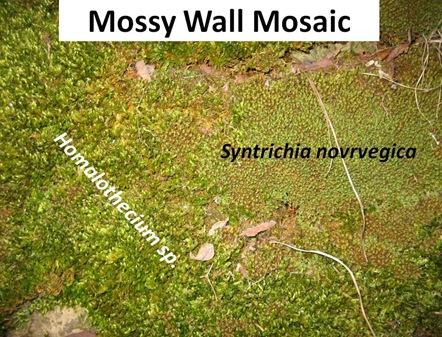
Mossy Wall Mosaic The brushier, “fuller “-looking moss has what I’ve been calling “Bottle-brush” heads, which are visible in the photo below. This is a species of the genus Homalothecium, which is one of 135 genera in the order Hypnales. The Hypnales are known as “Feather Mosses”, which come to think of it, is a much better name than “Bottle-brush.”

Homalothecium Closeup The “lower” looking moss has what I’ve been calling “spiky/leafy” heads, and is probably Syntrichia norvegica. What I like about this photo is that you can clearly see sporophytes (the diploid generation) in the upper right.
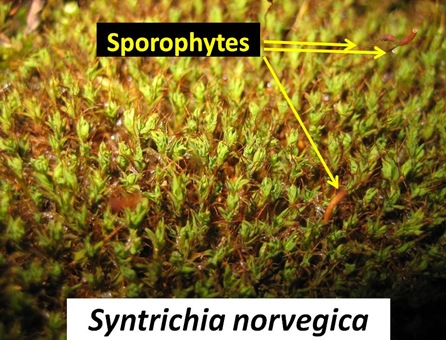
Snorvegica Closeup Tangent: So although I suck as a wildlife photographer, can we just agree that these are some totally rocking moss photos??

The genus Syntrichia belongs to a completely different order- Pottiales- and so the Mossy Wall, which I thought was just one species of “moss” is actually a mosaic of 2, very different and distantly-related species.

Back to the Desert

OK, so now that I’ve been set straight on the mosses on my favorite rock wall, let’s get back to St. George. This moss, below, is all over the place down there (this photo is from the Church Rocks trail, right by the culvert that goes under I-15.). It belongs to the genus Grimmia, and is most likely Grimmia laevigata, commonly known as either Cushion Moss or Dry Rock Moss.

Glaevigata closeup G. laevigata is one of the toughest, most widespread, successful plants on the planet. It occurs on every continent except Antarctica, and in many areas in the Southwest- particular granitic boulders- it is the dominant plant. Despite its worldwide distribution, it shows little genetic variability across the continents, a characteristic that has made it the subject of much interest to, and study by, bryologists.

Grimmia Church Rocks G. laevigata is a “pioneer” moss, in that it is often the first thing to colonize exposed granite surfaces, frequently even before lichens. But the absolute coolest thing about G. laegivata is its desiccation tolerance; it can be completely dried out for 10 years or more, then spring back to life, green and soft, when the rains return. In fact what ultimately limits G. laegivata from growing in even drier, sunnier, hotter places isn’t the lack of moisture, so much as its ability to maintain an viable carbon balance under extreme cycles of rapid desiccation (caused by direct sunlight) and rehydration, which is why, in the desert, you generally find this moss on North-facing rocks.

Common as G. laegivata is, there are plenty of other mosses around St. George. Below is another Grimmia species, G. pulvinata. This is another great photo, with lots of distinctive, down-turned sporophytes visible.

Gpulvinata closeup Back on Zen trail, occurring alongside G. pulvinata, is another spiky/leafy-headed moss, and it turns out that this is another Syntrichia species, probably either S. papillopsissima or S. ruralis, and a close cousin of our Mossy Wall S. norvegica back home. I love this one; I think it’s the prettiest close-up moss- and maybe one of the best-looking plants overall- I’ve ever seen.

Spapillosissima Closeup The thing that fascinates me about these mosses is this: I’ve mentioned before that one of the things I like about trees is being able to look around and know where you are- region, altitude, etc. Spapillosissima2 A bryologist can do the same thing with mosses, but with a perspective that is an order of magnitude greater than a tree-lover because there are so many more species of moss around- almost like the difference between looking at the world in human (trichromatic) color vision and Pigeon (pentachromatic) color vision. In any given canyon in the Wasatch there are probably more species of moss than there are trees in the entire state of Utah, and while most of us amateurs can’t hope to recognize more than a handful of species, just some basic understanding of mosses can give you at least a glimpse of the amazing “smaller-level” botanical richness and variety all around.

IMG_8132 But cool as Mosses are, Lichens are even cooler and weirder. Because though they seem to spread and grow like plants, they’re not quite plants, but rather an amazing symbiosis of the most basic of all plants and that weird, so-hard-to-get-your-head-around, third great kingdom of multi-cellular life: Fungi.

Special Thank You: I am exceedingly grateful to Lloyd Stark and John Brinda, University of Nevada, Las Vegas, for their time and efforts in identifying the species highlighted in this post, as well to Larry St. Clair of Brigham Young University for (repeatedly) forwarding my inquiries and photos to Lloyd and John. The assistance and courtesy extended to me repeatedly by botanical researchers and specialists has been, and continues to be, one of the most rewarding aspects of this entire project.

(Larry, by the way, is a lichenologist, and the star of my next post.)

Wednesday, February 25, 2009

St. George Weekend Part 2: Fun, Family and Fungus

So, like I was saying, we had a great weekend in St. George. I’m going to cover 3 things in this post: mtn biking stuff, family stuff, and plant/fungus stuff.

I left work early Friday, so we were able to drive down in daylight. As we descended past New Harmony and down towards Toquerville I was surprised to see snow levels extending down to 4,000 feet, ruling out Gooseberry and Little Creek. So my dawn rides were down on the Floor level, close in to St. George, which turned out to be a blessing because it led me to a new (for me) ride: Zen Trail.

Part About Biking

Zen Features OK, so why didn’t anyone tell me about Zen trail before? This trail is amazing! Fun combination of tricky technical, fast singletrack and killer views. And to top it all off is its convenient location- the trailhead is probably 10 minutes from I-15. I rode it shortly after dawn, and saw no one, except for this hiker/camper, whom I salute on his (or her, couldn’t tell) outstanding campsite selection.

ZenMap Side Note: UtahMountainBiking.com implies that Zen Trail is tougher than Gooseberry- it’s not. Though there are a ½ dozen or so Gooseberry-like moves (which can easily be walked) the vast majority of the ride is ledgy singletrack, similar to the semi-technical sections of Barrel Roll, but maybe 25% more technical…

Zen View SW The riding was wonderful. It was my first aggressive riding on tubeless, and everything worked flawlessly. And yes, the ride felt a bit different, but since I’m running new tires (which I hadn’t previously run with tubes) this call is extremely unscientific, and I can’t honestly say whether tubeless has a different feel, or if this was just some “Emperor’s New Clothes” placebo effect…

Tangent About The Fat Cyclist And Tubeless: So when I was debating whether to go tubeless, I asked a number of tubeless friends about it, all of whom recommended it. One of them was my coworker, the Fat Cyclist. Fatty said, oh yeah, tubeless is great, no problem, you’ll love it, totally hassle-free. So I went for it.

I spent 4 frustrating nights in a row in my garage screwing around with sealant, a compressor and bucket of soapy water chasing down mystery leaks. Finally, after nearly a week, I got the first tire to seal and hold air reliably. A day or so later I saw Fatty at work and mentioned my experience. Fatty said, “Hey you’re a braver man that me!” Confused, I asked what he meant? He said, “Oh I never install tubeless myself- I always take my wheels to the shop! And yeah, it always leaks, I pump up my tires before every ride…” Uh, thanks Fatty- that would have been excellent information to have before I went tubeless…

Anyway, I’m happy to report that both tires are leak-free, though there is probably about a quart of sealant in my front tire now…

Part About Family

So it’s taken me 9 years, but I have finally actually come up with a bit of Genius Parenting Insight. Are you ready? Here it is: Kids Love Animals. That’s it, and yes it took me 9 years to figure it out.

Kids Love Animals This weekend we took the Trifecta to amazing vistas, a national park, and a volcanic lava field, but the absolute hits of the weekend were the 2 fenced fields we drove by: 1 with elk and bison, the other with ostriches and emus. Bird Whisperer was particularly enamored with the birds, both ratites, whose eating habits and Gondwanan origins he informed us of in detail. (Yes, my 9-year old knows about Gondwanaland and Ratites. How scary is that? Next year I may just retire and hand this blog over to him.)

Part About Fungus and Plants

My favorite desert rides are in the Spring, when there are all sorts of things blooming and flowering. IMG_8157 Nothing is blooming down around St. George yet, but the lack of “action” in the desert made me pay closer attention to some of the small-scale things going on. First, the Blackbrush, Coleogyne ramosissima. On close inspection, they’re covered with these light, green “proto-leaves”. In the coming weeks they’ll grow, darken up and acquire a tough, waxy coating. This is the first time I’ve seen them at this stage, and I think it’s one of the earliest indicators of Spring I’ve ever noticed in the desert.

IMG_8166 Second was this: a witches broom in Mormon Tea, specifically Ephedra viridis. I’ve seen plenty of brooms in both conifers and angiosperms, but never before on a gnetophyte. Whether this is a parasite or a mutation (either can cause broom-like growths), I don’t yet know, but I plan to return to brooms later this Spring/Summer.

IMG_8160 But the most interesting was this: all the stuff growing on rocks. I never saw desert mosses look greener, healthier or lusher, and the relative lack of other plant colors around, really made the lichens stand out, and it’s these guys- moss and lichens- that I want to dive into in the next couple of posts.

But first, a brief detour, as I address a reader’s urgent plant-related question.

Next Up: All About Ski Bike Junkie’s Yard

Sunday, November 23, 2008

The One Really Green Thing

Sometimes, right before bed, I find all of a sudden that I’m really thirsty. Somehow over the last couple of hours I suddenly realize that I haven’t drunk anything in a while. But when I drink water, it doesn’t seem to slake my thirst, and no matter how much I drink, I still feel thirsty until I drink something sweet, like orange juice or a glass of Gatorade.

That’s sort of the same feeling I get this time of year when I go a few days without seeing something green. Not dark, almost black PLT-green, not dull olive green of Mountain Mahogany, and not the fading drab remnants of the few yet-to-shed leafy trees of the valley. I miss real, green. Bright, living, photosynthesizing green, and no matter how many pretty mountains or hills I look at, I’m still left thirsty for color.

The Mossy Wall

IMG_7435 There’s one spot of color in the foothills that I visit several times a Fall/Winter. It’s 4.2 miles from my house by mtn bike, and I call it- imaginative fellow that I am- The Mossy Wall.

Since starting this blog, I must’ve blogged about, or at least mentioned, more than 100 different plants, both here in Utah, and in my travels further afield. And what all of them have had in common, the pines, the PLTs, the Redwoods, the Oaks and Maples and Bitterbrush and Creosote and Cycads, and Gingko and Mormon Tea and all the rest, is this: they are all Tracheophytes, or vascular plants.

IMG_7422 The evolution of a vascular system, of xylem and phloem, was probably the 3rd-most significant evolutionary step in the history of plants (the 1st being chlorophyll, the 2nd being the symbiotic evolution of chloroplasts and cyanobacteria.) It made trees, shrubs, flowers, grasses and fruits all possible. But to watch through world through only vascular plants is to ignore the other 3 great divisions of land plants: the liverworts, hornworts and mosses. Of these, the mosses are the most common and numerous, with an estimated 20,000 species, making them second only to angiosperms in diversity.

Tangent: In a lot of “plant family tree” charts, liverworts, hornworts and mosses are lumped together, apart from the Tracheophytes. This isn’t quite accurate, as there’s not really any evidence that the 3 comprise a monophyletic group, or are more closely related to each other than any one of the 3 is related to the Tracheophytes.

Mosses, or Bryophytes, are divided into 6 classes. One of those classes, Sphagnipsoda, includes just 2 genera, one of which is Sphagnum, or Peat Moss. The Mossy Wall moss is peat moss. There are a couple hundred species of peat moss worldwide, and unless you’re a bryologist, well… forget about IDing the species. Mosses are notoriously hard to ID, and many can’t even be identified by a bryologist (yes, there are people who apparently make a living study mosses. How do I get that job?) using a hand lens! So I’ll settle for the genus.

IMG_7421 Mosses have no xylem, no phloem, and no roots. They attach to rock, soil or other surfaces via gripping structures called rhizoids, which look like little roots, but don’t do any of the water or nutrient transport things that real roots do. They just grab and hold on, that’s it. Mosses don’t store water; they just live off of whatever water’s around at the time- rain, dew or snowmelt.

IMG_7418 The peat moss of the mossy wall is a wonderful lush luxuriant green year-round. It lies on a North-facing wall in a canyon bottom at 5,700 feet. The canyon-bed is ride-able (though technical) and as you pedal or hike your way up, you wind around one gray/brown leafless bend after another, until- BAM- you get hit with a blast of color, a mat of green that seems so weirdly, wonderfully out of season, and your eyes finally find the drink they’ve been thirsting for.

IMG_7426 I can never resist removing a glove and laying a hand on the soft carpet- the only natural, soft thing in the dead of winter for miles around. The touch and the sight warm my heart against the color-less cold of a Wasatch winter.

Dry Creek Map Caption Tangent- Location: The Mossy Wall is located in the bottom of Dry Creek Canyon, but ½ mile above where the Bonneville Shoreline Trail (BST) turns way to the West and climbs out of the canyon bottom. Though not an official trail, it gets ridden and hiked for close to a mile up pretty regularly. This “trail” as it were, became somewhat better known after the 2003 rescue of Elizabeth Smart as it leads to the primary initial campsite of her abductors. Many locals know it as the “Elizabeth Smart Trail.”

I mentioned this route in a previous post, when describing the location of my favorite Bigtooth Maple Grove, which lies 1.5 miles up-canyon from the BST junction. Alas, when I last attempted the uppermost ½ mile in the Fall of 2007, I found it hopelessly overgrown for a mountain bike.

The First Cool Thing About Moss

So why does moss stay green all winter long when everything else around is brown? The answer is their simplified architecture. Most flowering plants can only perform photosynthesis with a net gain in energy at temperatures down to around 50F. Much below 50F, and the demands of producing and moving the sugars around inside burn more energy than is produced by photosynthesis, and this is the reason why most flowering plants stay dormant in the winter.

Tangent: There are a number of early-blooming wildflowers, such as Glacier Lilies, that grow and bloom even before the snowmelt, but these plants are using stored energy reserves from the previous year. Even conifers, such as PLTs, don’t photosynthesize during most of the winter, though their evergreen needles allow them to do so opportunistically during warm spells.

IMG_7425 But without a complex vascular system to support and modulate, mosses can photosynthesize with a net energy gain at temperatures down to just above freezing, and that’s why it maintains its lush green color throughout the winter.

The Second Cool Thing About Moss

But the really weird thing about Moss is its genetics and reproductive strategy, which is way, way different from that of tracheophytes or anything else we’ve looked at.

Mosses exhibit a characteristic called Haploid Dominance, which means that in its “dominant” state, or the way we most often encounter it, it is haploid, having just 1 set of chromosomes. But it reproduces via alternating haploid and fully diploid generations, meaning that a haploid parent produces a diploid offspring, which in turn produces haploid offspring and so on and so on… So in other words, when you look at moss, here’s what’s going on:

The peat moss on the Mossy Wall is haploid, meaning that each cell contains only 1 set of chromosomes, which in Sphagnum is 19 chromosomes. The haploid generation is called the Gametophyte generation, and it is this generation that performs photosynthesis. Mosses in the haploid state can either be male, female, or both. The male organs, called antheridia, occur on different stems (yes moss has zillions of little stems) from the female organs, which are called archegonia.

Moss Repro1 Mosses never evolved pollen; they reproduce via sperm and eggs. Each sperm or egg cell is also haploid, and therefore each one contains all 19 chromosomes of the moss producing it. Pollen was another wonderful evolutionary step in tracheophytes; it enabled the dispersal of genetic material for many miles from the parent. But moss-sperm travel the old-fashioned way: they swim (like animal sperm) and this means that mosses can only mate with very close/adjacent mosses and they can only do so when wet.

Moss Repro2 When egg and sperm do successfully meet up they unite to create a single, fully diploid (38 chromosomes), cell which grows into a fully diploid moss called a Sporophyte. A sporophyte doesn’t expand or photosynthesize, and in fact it lives its whole life attached parasitically to its “mother”. Sporophytes do one thing, which is to create (via meiosis) and disperse haploid spores. The spores are borne at the end of tall (relative to moss that is) stalks and carried away by the wind. Ideally some of the spores land in suitable locations for moss growth and then develop into an new, haploid, gametophyte generation. Mosses also reproduce clonally, or vegetatively, like so many other plants, and such reproduction represents simply a continuation of the haploid gametophyte.

IMG_7417 Mosses are way more common in wetter climes. I used to see them all over the place in New England and of course they’re everywhere in the Pacific Northwest. But this relative rarity of extensive mossy areas here in the Intermountain West somehow makes them more amazing and wonderful- isolated patches of soft, living, breathing green in the midst of the cold, dead desert winter. Over the years I’ve come to think of the Mossy Wall as an old friend that helps to focus and encourage me, reminding me of the living year to come.