So as everyone who reads this blog knows, the Watcher-Family-Unit had an outstanding vacation last month in Costa Rica. I blogged about the amazing mammals, birds and plants we saw down there, but unfortunately, none of those posts was a good place to blog about the innumerable Creepy-Crawlies we encountered on our trip. And so I’m belatedly doing this Special Bonus Post to give equal time to the various things we saw that slither, scuttle and/or sting.
But first, I must define the term Creepy-Crawly. For purposes of this post, to be a Creepy-Crawly, a creature must meet 1 or more of these 4 strict scientific and highly technical criteria:
1- It’s an invertebrate
2- It’s a reptile
3- It’s something that can sting, inject venom, harm, cause pain to, or otherwise make miserable a human being.
4- It’s something that, if your kid sister found it her bed, she would Totally Freak Out.
I recognize that this list is a bit broad (and in fact as I review it, I realize that technically my first wife would qualify*) but hey, it’s good enough.
*Meets criteria 3 & 4.
 There honestly wasn’t a single day of our vacation that we didn’t encounter at least one exciting Creepy-Crawly. On the very first day, on our drive down to Quepos, we hit a home run with the kids by stopping at the bridge over the Rio Tarcoles, probably the best-known Crocodile-watching spot in all of CR. For years, tourists have stopped, watched, and (illegally) fed the several dozen Crocodiles that congregate under the bridge. Here’s a short video of another tourist dropping a road-killed Boa Constrictor into the Croc-infested waters below.
Side Note: Yes, even the road-kill in Costa Rica is exciting; that really was a Boa he dropped.
Crocodiles, Alligators and Caimans
The order Crocodilia has been around for more than 80 million years, and includes 3 families. The first is Gavalidae, which includes only 2 species, Gharials and False Gharials, native to Malaysia and India respectively.
The second is Alligatoridae, and this includes Alligators and Caimans. Alligators are what you’re likeliest to see in Florida. Though there used to be dozens of different species, there are only 2 species today, the American Alligator, Alligator mississippiensis, and the Chinese Alligator, Alligator sinensis. Alligators are the only crocodilians whose upper jaws are bigger than the lower jaws, and therefore completely cover the lower teeth when the mouth is closed. So if the mouth is closed and you see lower teeth, it’s not an Alligator. A. mississippiensis is native to the Gulf Coast/Florida and doesn’t make it down to Costa Rica.
Caimans are a bit smaller than most Crocs and Alligators, generally no more than 2.5 meters in length. There are 6 species, all native to South America. One, the Spectacled Caiman, Caiman crocodilus, makes it up into Central America and Costa Rica. Caimans were on Bird Whisperer’s “Target List”, and we looked hard for them, but to no avail.
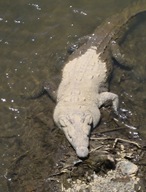 The third family is Crocodiles. There are over a dozen species of Crocodile, spread across Asia, Africa, North & South America and Australia, and these include the biggest, meanest and most dangerous Crocodilians. The one found in CR is the American Crocodile, Crocodylus acutus. C. acutus grows up to 6 meters in length, and can swim up to 20 mph. Attacks on humans are unusual, but not all that rare. (Our guide in Quepos knew a fellow who’d lost a leg in an attack last year.) Crocodiles are generally more territorial, larger, and likelier to attack humans than Alligators. But (thankfully) the Crocs likeliest to attack humans are the Saltwater and Nile Crocodiles, found only in the Old World. Crocs are of course a regular threat to dogs in CR; as we returned from a Mangrove tour, a dog scampered among the reeds along the bank, chasing something. I overheard our guide say to the boatman, “No dura tres dias mas…” (“He won’t last another 3 days…”)
 It’s one thing to see Crocodiles from the safety of a bridge; it’s another to find them lurking in the mangroves. Check out this shot on the right, and then see if you can find the one hidden in the pic below on the left.
 2 other interesting differences between Alligators and Crocodiles: Alligators tolerate cold water (down into the 40’s F) far better than Crocodiles, which is why Alligators have done so well in the Southeast. But Crocodiles handle salt water better than alligators, which is why they’ve managed to colonize a number of Caribbean islands. In fact it’s thought that the small population of Crocodiles in Florida (~1200 individuals) arrived by island-hopping from Cuba during a previous ice age (when sea levels were lower.)
Spiders!
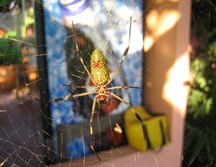 A few hours after our stop at the bridge, we arrived at the Blue Banyan Inn. As we were walking past the lobby/pavilion on the way to our cabina, a glint of glittering gold caught my eye. It was a spider web, a huge web, maybe 4 feet across, with thick, well-defined strands that caught and reflected the afternoon sun. And in the center of it was the most stunning, beautiful spider I’d ever seen- a Golden Orb Spider, Nephila clavipes.
There are 2 creepy things about Golden Orb Spiders. 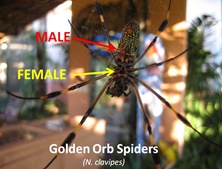 First is its size: about 4-5” in leg-span, and the abdomen alone is between 1” and 1.5”. The females are way bigger than the males. In fact in this pic- get this- I got the female and the male. Despite their size, they’re not particularly dangerous; though their venom contains neurotoxins chemically similar to those in Black Widow venom, they’re far less powerful, and the bite is usually no worse than a bee sting. (For a description of the neurotoxins in Black Widow venom, see this post.)
The 2nd creepy thing is the web- it’s tough. After we settled into our room and had a swim, I went for a run.  The old 4WD trail I was running on quickly deteriorated into a partially-overgrown jungle track (looking like pic on right), but I persevered. (Probably not my brightest move, as we’ll see when we get to snakes.) A few dozen yards later I felt a sharp yank across my thighs, as though I’d hit a trip wire. Quickly looking around, I saw a Golden Orb female scuttling up a broken web-strand and into the brush. Though the web gave way immediately to a running 175 lb human, it was the strongest spider-web I’ve ever felt. (Supposedly pre-Columbian Americans used them for fishing lines.)
The distinctive yellow tint of the web is caused by a combination of 4 compounds, and is thought to serve 1 or 2 possible functions. The first is camouflage in jungle brush; the second is to attract bees, which are often caught and consumed by the spiders. We saw plenty of Golden Orb Spiders in and around Quepos and Manuel Antonio, but none in the high country. “Golden Orb” BTW, refers to N. clavipes’ web, not her abdomen.
 The lowland coastal jungles had many other interesting insects. One of the fascinating things about ants and termites in the neotropics is that they often build their nests in trees (pic left). If you’ve been to Central America, you may have notice that trees in parks and in towns are often painted white around the base, for the first 3 feet up or so. Supposedly the paint serves to dissuade ants and termites from ascending the trunks and colonizing the trees.
Tangent: On my previous CR trip with Bird Whisperer, I ate a live termite, at the encouragement of a guide. It tasted faintly of peanutbutter.
 Nested Tangent: “Peanutbutter” is one of those words that will drive you crazy in Spanish. In Mexico it’s “Crema de Cacahuate.” But in Spain, it’s “Maneca de Mani”. In a Costa Rican supermarket I asked for it by both names, and received quizzical looks until the clerk realized I was looking for “Crema de Mani.”
 Another word that’s like that in Spanish, and one that comes up for us a lot when we travel, is the word for non-identical twins (pic left = ours.) The word for identical twins in Spanish is “Los Gemelos.” But different Spanish speaking countries have completely different words for non-identical twins. In Mexico, it’s “Los Cuates”, in Spain, “Los Medizos”, in Cuba, “Las Jimaguas”, and in Colombia and Venezuela, “Los Morochos.” In Costa Rica, it’s just “Los Gemelos”; apparently like us English-speakers, they use the same word for both types of twins.
 Snakes!
OK, let’s get back to reptiles. Here’s something else we saw in the mangroves- a Mangrove Boa (pic right). This guy lays about during the day, then prowls through the branches at night, hunting for birds, monkeys and other snakes. What happens when it catches one? We’ll get to that in a moment. We saw a few other snakes in the wild on our trip, but (much to the dismay of Bird Whisperer) no venomous ones. But venomous snakes are common in Costa Rica, and we learned quite a bit about them while we were there.
When we checked into the Blue Banyan, we received only one warning: kids stay out of the brush. Every gardener or agricultural worker we saw in and around Quepos wore knee-high rubber boots. (Now you know why my jungle-run probably wasn’t so smart…)
 In Costa Rica- a tiny little country- about 600 people get bit by venomous snakes every year. Fully half of those bites are the work of just one species: the Fer-de-lance, Bothrops asper. The Fer-de-lance does not have the deadliest venom of Costa Rican snakes- that distinction goes to the Coral Snake. But it is far and away the most dangerous, as it is aggressively territorial.
If you’re like me, and you do a lot of hiking in the Western US, you’ve probably had a Rattlesnake rattle at you. And probably, like me, you jumped back and thought “Phew- close call!” But you probably weren’t bit; the Rattlesnake was warning you off. Now imagine if instead of warning off, that rattler came after you and tried to bite you. That’s what a Fer-de-lance often does.
 Tangent: I’ve had oodles of run-ins with Rattlesnakes. See this post for a description of backpacking in a Rattlesnake-infested canyon in Southern Utah. But my all-time best Rattlesnake story is this: in June 1996, I jumped my mountain bike over a rattlesnake* lying across the trail as I was descending the singletrack off of Lewis Peak up in Ogden.
*Not as crazy as it sounds. I was moving at 20-25 mph and didn’t see it till it was 6-10 feet in front of me. It was bunny-hop or roll over it, and fear made me hop before I could think about it. So really, not crazy at all. Not like this or anything…
But here’s the bright side of the story: of those 600 bites per year, only 1 or 2 are typically fatal. Costa Rican hospitals and clinics are extremely well-stocked with antivenins, and the fatalities that do occur are most often due to bites that happen in extremely remote parts of the country, from which a medical facility can’t be accessed quickly enough.
Lizards!
 CR also has plenty of cool lizards. Here’s a Common Basilisk, Basiliscus basiliscus, (pic left, not my best photo) we spotted basking in the mangroves. It’s also known as the “Jesus Christ Lizard” because 3 days after it dies it rises from the dead. Haha! A little Holy Week humor for you there. No, it’s called the JC Lizard because it’s able to run across the surface of the water for distances of up to 20 meters before sinking (after which it swims along just fine, though not as quickly.)
 Iguanas are also common in CR, as is this guy, which looks like an Iguana, but isn’t. It’s a Ctenosaur (pronounced “tina-sore”), specifically a Black Ctenosaur, Ctenoaura similis. It’s native from Mexico to Panama and in CR you’ll see them all along the Pacific coast.
Tangent: It’s also been introduced (as escaped/discarded pets) into both Texas and Florida.
 When you see a Black Ctenosaur, it’s pretty much always like right here- basking on the sun. But when it wants to, this guy can haul ass. C. similis is the fastest lizard on the planet, and has been clocked at a max speed of almost 22 mph.
Special Side Note – Sepentario Monteverde: Though this blog focuses on critters in the wild, I’d be remiss if I didn’t mention the amazing reptile zoo up in Santa Elena, Serpentario Monteverde. This place was a total 100% hit with the Trifecta, and afforded us an opportunity to see several snakes we didn’t see in the wild, including the Fer-de-lance, Coral Snake and several Boas.  It also houses a great array of turtles (including an Alligator Snapper) and several Poison Dart Frogs. Best of all, you and your kids can pick up and handle (under supervision) various, non-venomous reptiles. Here’s a shot of Twin B holding a local native snake, the Iforgottowritedownae whateveritsnamewasii. (I would like all readers to note how fabulously cool it is that my daughter has absolutely zero fear of snakes. Her gemelo wouldn’t touch it.)
 Another interesting- but unnerving- thing we saw at the reptile zoo was this Boa feeding on a live rat. I couldn’t bring myself to take a video (seemed just a bit too ghoulish) but you can get the idea from these 2 shots (left and below, right). Whole process took about ~8-10 minutes.
 Up in Monteverde we encountered a number of other Creepy-Crawlies. One piece of advice I have for anyone visiting the cloud forest is to bring along a small flashlight. When you pass a trailside embankment, it’ll often be riddled with small holes, and the light will allow you to peek inside. Holes without webs are the most promising, as it means it’s regularly used by some critter entering/exiting.
More Spiders!
 Here’s an Orange-Kneed Tarantula, (genus = Brachypelma, unclear on species), we found in one such hole. It’s a female, waiting out the day in (relative) safety before emerging to hunt at night. (I mentioned the monster-sized Costa Rican Tarantula Hawk Wasp I spotted later that day in this post.) This is a common tarantula up around Monetverde, and it’s a looker, with a Halloween-ish orange & black color pattern and a leg span of up to 8”.
There are 900 species of Tarantula in the world. Here in Utah the one we get is Aphonopelma iodius.  I’ve spotted them while biking or hiking probably about a dozen times since I’ve lived here, always between July and October. October is most common, when you’ll see them crossing roads, but I’ve also seen them on the Shoreline trail just before dawn in the Summer months. (This photo was taken in late October along Shoreline behind the U. of Utah Hospital.) When you see a Tarantula walking about in October, it’s almost always a male. In general when it comes to Tarantulas, males roam, females park.
Tarantulas sure look scary, but they’re pretty harmless to humans, with a bite not much worse than a bee sting. And despite what you saw on the Brady Bunch, I’ve never encountered, or even heard of anyone finding, a Tarantula in their hotel room, much less their bed. But they’re a lot scarier to some smaller mammals; Orange-Kneed Tarantulas hunt (among other things) mice. When they catch one they paralyze it with a venomous bite, then inject it with digestive juices that liquefy the mouse’s insides. Over the next several days they’ll suck the mouse dry, leaving behind an empty sack of fur and bones.
 Scorpions!
But here’s a Creepy-Crawly you are likely to find in your Costa Rican hotel room. I like to say that no Central American vacation is complete till you find a Scorpion in the bathroom, and I’ve encountered them in hotel bathrooms in both Costa Rica and Belize. Here’s the one I found in our Santa Elena Hotel (and promptly dispatched with a deodorant stick.) There are over 2,000 scorpion species in the world, found on every continent except Antarctica. 7 of them are native to CR. I believe this one is a Bark Scorpion, probably Centuroides margaritatus (or possibly C. limbatus.) Though the sting of either species is apparently extremely painful, neither appears to be as dangerous as the Arizona Bark Scorpion, Centruroides sculpturatus, which, before antivenin became widely available, killed a few hundred people a year in Mexico.
Scorpions are fascinating and ancient; they’ve been around for something like 400 million years.  They’re common here in Utah (we have 9 species), and so I’ll return to them in a future post. But fascinating as Costa Rican Creepy-Crawlies are, this post has run on long enough, so I’ll wrap up with this photo of an unknown Centipede Bird Whisperer spotted in Monteverde. And remember, when vacationing in the Neotropics, shake out your shoes in the morning.
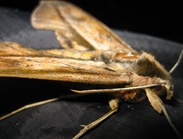 Side Note: Missing from this post of course is are the Vampire Bats and Bullet Ant we saw, which I’ve already blogged about in this post and this post ,respectively. I also, regrettably and in the interest of time, had to omit over several other wonderful Creepy-Crawlies we encountered, including Leaf-Cutter Ants, Frogs and Toads, a tree with poisonous bark (Manzanillo) and the Biggest Moth Ever (pic right.)
That’s 4 posts I’ve done on our Costa Rica trip. Seriously, do I get my money’s worth out of a neotropical vacation or what?


