Thursday, October 9, 2008

When To Back Down

I had another post planned for today, about red squirrels and fir cones and stuff on the trail, but I’ll hold off for a day to post this quickie.

My boss was in town this week. He works about 2,500 miles away, spends maybe 6-8 days a month in my office (which, when I think about it, is pretty sweet. I should quit whining about my job…) Late this morning we had a long, drag-down meeting where we disagreed on something. When we wrapped up, I stated my position, why I felt that way, and said something to the effect of: you’re the boss, we’ll do it your way, but this is why I think you’re wrong.

IMG_7003 I was a bit wound up afterward, and decided to press my Happy Button- a long lunch/ride. I did the PBX loop (one last time before the weather pulls a “winterito” -little Spanglish for you there- on us this weekend, with snow/rain and highs in the low 40’s…) I was riding great, cleaning all the switchbacks, when I ran into this guy ½ way up “X Trail”. He was square on the trail, a switchback above me, and a cow was just 20 feet ahead of him. They/he (not sure) was making weird moaning/low-bugle-y noises, and it occurred to me that this is likely mating season.

Side Note: I mention a lot of trail locations in this blog. If you ever want directions to a place or thing mentioned here, you can either leave a comment or email me at adventurebotanist@yahoo.com. (Is that the best email address ever or what?)

So I did what I normally do, which is stop and start talking loudly, hoping he’ll move off. But this one didn’t. He was standing his ground, and right after I snapped these photos, he started bashing some brush and moving towards me. I got out of there fast, stopped ~100 yards down-trail (he didn’t chase) waited about 3-5 minutes, and climbed back up a couple more switchbacks. They’d moved up-trail a bit, but were stopped again.

Moose Back Down Map Tangent: What did I talk about? I told the moose that a) I wasn’t a threat, b) I wasn’t competing for his mate, and c) he really should regard me highly, as I was a big-time nature-blogger who’d done a 2-part series on moose earlier in the year, and in fact I was likely the only mtn biker he’d ever run into who knew both his subspecies (shirasi) and number of chromosomes (68.) I conveyed this in a mixture of English and Spanish. I often speak in Spanish when addressing animals because a) any Anglos around probably won’t understand and b) it’s nice to practice with an audience that can’t criticize my horrific Spanish grammar. He seemed unimpressed with all of my arguments, por ambas idiomas

IMG_7004 I’ve never backed off from a moose (OK except when they are actually chasing me) and in fact I often make fun of Organic-Chemistry-Rick (guy who refuses to read my blog) because he regularly 180s and changes his ride-plan when encountering them. (Rick is also afraid of dogs, which I used to tease him about incessantly, until one -a weimereimer- bit me last year (how’s that for karma?), also in Pinebrook- I swear it is like a wild-animal safari up there!)

So I spent a moment thinking about life, how I’d kind of pushed it a bit with my boss, how I’d been a bit aggressive about things in general lately, how I’m in my 40’s with 3 kids to put through college, and that this might not be a bad time to back down. So I did, pulling a re-route and getting back to the office a bit later than planned.

Tangent: 10 years ago yesterday was my only car/bike accident. 9 years ago today I was saved from a 40 foot fall off a cliff by a Cliffrose (not Bitterbrush- I was mistaken.) Both these anniversaries crossed my mind as Alces alces shirasi and I stared each other down.

When I returned to the office my boss was looking for me (why does that only happen when I sneak out for a ride?) and wanted to talk. He’d thought about our meeting, and had decided I was probably right. He backed down.

There’s some lesson in here somewhere. Just haven’t figured it out yet.

Tuesday, October 7, 2008

Housekeeping Post – Adding a Blogroll

This is a quick housekeeping post. I’ve decided to add a blogroll. I’ve always been down on blogrolls, but I’ve decided to lighten up.

Tangent: Here’s why I’ve been down on blogrolls. You go to some blog, and the last post is like 8 months old, and it says something like, “Not much happened today. Watched Law & Order. Ate some soup.” And then on the right there’s this giant roll of like 75 blogs, and you click on one and it takes you to a another blog that hasn’t been updated in, say 14 months and it says something like, “Rained again today. Ate some chicken.”

The other reason is I have a sort of quiet, just-below-the-surface, semi-latent, quasi- passive/aggressive antisocial streak (which is probably part of the reason I so enjoy the types of solo backcountry adventures I often blog about) and this manifests itself in countless little meaningless gestures of social rebellion like not responding to Linked In invites (ha- showed them!) and acting all kind of snotty towards people who watch popular TV shows, like “Dancing with B Actors” and “Law & Order(Christ I hate that stupid show) or whatever. I’m not sure where this streak came from, but I suspect it had something to do with a childhood of being picked last for sports teams (yeah well who wants to run up and down a stupid field anyway?) or that time in 6th grade dance class when it was ladies choice and I was the last guy picked to dance (yeah, well I’m tired anyway, I’d way rather just sit here and take it easy…) (Really, I was the last guy picked. If they’d had a Least Desirable By The Opposite Sex award in grade, junior high or high school, I would’ve won it hands down. How I wound up with Awesome Wife is thoroughly beyond me.)

OK, but I’m adding one anyway. There are a couple of reasons, primarily consideration to those who’ve linked to me, but also because after staying up late on nearly 100 nights to draw dumb graphics and research everything from Weevil genetics to the flight-load capacity of Clark’s Nutcracker, it’d feel good if I thought someone actually read this blog on occasion. So I’m linking to these 4 blogs:

Gerald Desert Explorer. Steve and I met Gerald back in May in Twin Corral Box Canyon and chatted about all the close calls with rattlesnakes we’d experienced. Gerald is a hard-core desert rat, ultra-light backpacker and former special forces guy whose blog details many of his desert adventures and links to his website, which is full of useful info related to ultra-light backpacking and backcountry desert adventures. Gerald was the first guy to link to- and say something nice about- my blog.

Mark 014 UTRider. Mark is a local cyclist, both road and mtn, and occasional racer, who blogs regularly about his rides, with plenty of photos, mostly in the Wasatch, occasionally further afield. You can think of his blog as all the good cycling stuff of my blog, but way more of it, and without all the geeky-obsessive wannabe-botanist/ entomologist/ hydrologist stuff. Mark included my LOTOJA post in a compilation post he did of LOTOJA race reports last month, and was kind enough to include my blog in his roll.

funicular kristin Periodic Ponderings. Kristin has always been one of my favorite coworkers- intelligent, helpful and one of those people who can be direct, honest and charming all at the same time. Her blog reads the same way, and she was also kind enough to include my blog in her roll early on, when a couple of coworkers first learned about my blog and probably thought I was nuts. (They still do. But they’re nice to me anyway.)

jill Up In Alaska. Jill doesn’t know (or link to) me, but I always enjoy reading her blog. She’s an adventure racer who lives in Juneau, and her blog does a wonderful job of giving me a feel for a part of North America I’ve yet to visit, along with wonderful tales of her ultra-racing adventures. And to be completely honest, I don’t think there’s any male cyclist between 15 and 50 who can read Jill’s blog for a couple of months without getting just a little bit of a crush on her.

OK, that’s it. That’s as sweet and syrupy and gracious as I get. Back to bugs and trees.

Monday, October 6, 2008

Has 6 Legs, Rhymes With “Evil”…

So I meant to include one more thing in my last post about acorns, but I totally spaced it. But since it’s like my best wildlife photo ever, I’m posting an update. Here it is, the Acorn Weevil, Curculio nucum. (Disclaimer: I’m not sure on the species- see below.)

Great Weevil Shot

Side Note: Seriously, is this a great photo or what? When I think of how far I’ve come as a wildlife photographer this year, it almost makes me weepy…

Lots and lots of acorns around here have teensy-weensy holes. The holes are almost always caused by Acorn Weevils or Gall Wasps. Both lay eggs in acorns, which their young use as a food source. I read somewhere that 25% of acorns in North America fall prey to Acorn Weevils, but I’ll bet it’s higher here in Utah; it’s hard to find an acorn without a hole in it, and this is one of the big reasons that scrub oak in the Wasatch reproduces clonally so much more frequently than by seed.

Depending on who’s counting, there are between 30,000 and 60,000 bugs in the world called “Weevil”.

Weevils are characterized by a long snout or beak which has evolved to bore into plants. The tiny mandibles are at the very end of the snout, so it chews into whatever plant matter it’s boring into. All Weevils are grouped together in the “superfamily” Curculionidae (which appears to be a monophyletic grouping, but I’ve been unable to confirm this in my brief review of the research…) which includes several thousand different genera.

2 Weevils I took these photos in a stand down by Dimple Dell that was practically covered with weevils; probably every 3rd acorns had 1 or 2 weevils on it, and every other acorn had at least 1 hole. Acorn Weevils belong to the genus Curculio, which includes around 350 species worldwide. I believe C. nucum is the most common around here, but that’s conjecture; I’m having trouble confirming it. In any event, after mating Curculio females search out a suitable acorn, bore a hole in it, stick their ovipositor down the hole, and lay an egg. Over the next few weeks the egg hatches and the larvae slowly eats its way out of the acorn. When it emerges it either crawls or falls to the ground and buries itself in the soil, pupating over the winter, and emerging as an adult the following spring to repeat the cycle.

3 Cool Things About Weevils

There are 3 amazingly cool things about Weevils, which I will list in order of coolness. The first is like Wasps, they’re an incredibly diverse group of insects that all share a common behavioral schtick, but have diversified into a gazillion species, each of which has zeroed in on a specific plant target/host.

boll-weevil The Weevil “schtick” is to parasitize plants to host its eggs. There are Weevils that go after cotton (the Boll Weevil, Anthonomus grandis, right) Weevils that go thistle buds (Canada Thistle Bud Weevil, Larinus planus) and weevils that go after leaves, fruits, leaf-buds, cactus pads, palm fronds- you name it.

Tangent: The Wasp “schtick” is similar; they lay their eggs in living things as well, but more often the target is animal (unlike Weevils, who target only plants.) There are specific Wasps that target everything from Tarantulas to caterpillars to figs.

Undertones Cover Nested Tangent: In this “schtick” aspect, Weevils and Wasps remind me of one of my favorite bands of the 1970’s: The Undertones. The Undertones had a “schtick”: every song had one really great, really catchy guitar riff. And that song would play that riff over and over again, just beating the crap out of it (but in a good way.) Each riff was unique, but each song had a very clear, very obvious riff. The Undertones were like a biological “family”; their “schtick” was a great guitar riff, and their songs were analogous to individual “species”…

Nested-Nested Tangent: But the absolutely coolest thing about The Undertones was the name of their lead singer: Feargal Sharkey. If I ever have a third son, I swear I’m naming him “Feargal”…

polyploidy The 2nd cool thing is that some Weevils are polyploid. We’ve talked about polyploidy in whole bunch of plants, but never animals. (For an explanation of polyploidy, see this post.) For a while biologists thought polyploidy was exclusive to plants, but over the years it’s been found in a few animals, including Salmon, Salamanders and Weevils.

And the 3rd cool thing is that a number of Weevil species in which polyploidy occurs- in different genera on multiple continents- have adopted a Dandelion-like genetic strategy.

Way back in April, when we looked at Dandelions, we saw that in Europe sexually-reproducing chromosomally diploid Dandelions live alongside apomictic, asexually-reproducing, chromosomally triploid Dandelions.(For an explanation of the absolutely wild genetics of Dandelions, see this post.) Incredibly, something similar seems to be going on with Weevils. In multiple cases a single species includes both diploid and polyploid races (specifically either triploid or tetraploid.) The diploids reproduce sexually, but the polyploids- all females- reproduce only parthenogenetically.

Side Note: We also talked about a Dandelion-ish sexual/asexual animal reproductive strategy last month when we looked at Aphids, but polyploidy wasn’t a factor with those guys…

Weevil Sexual Repro

What’s even weirder is that the polyploid females compete with diploid females for, and copulate with, diploid males, but the copulation is completely non-productive; the polyploid females just produce copies of themselves.

Weevil Asexual Repro

Tangent of Great Weirdness: When I read about these bizarre mating strategies I can’t help but try to imagine them in the human world. Imagine that the world was filled with 2 types of women; both consorted with and had sexual relations with men. But some portion of the women, who otherwise appeared “normal”, only become pregnant with, and gave birth to, copies of themselves. Is that like a freaky sci-fi plot or what? Only it’s not- it’s how things really work for (some) Weevils!

Man, I should do a Bug Blog next year. Bugs are way cool.

Friday, October 3, 2008

All About Acorns + Culinary Action Video

IMG_6628 If you’re collecting acorns, this is the time to get out in the foothills and pick them. And that might be a good idea if you are: a) a Jay, or b) a Squirrel, or c) a Person Who Knows How To Make Something Edible Out Of Acorns.

For the past couple of years, I’ve really wanted to be C, but I’m thinking it isn’t going to happen. And that’s a disappointment for 2 reasons, neither of them very practical.

road warrior pic First, I always like to think that in a pinch, if civilization broke down or something, I could live off the land. This is of course total BS. I don’t hunt, I’m a neophyte fisherman, and a lame forager. Earlier this year I blogged about my abject failure to dig up an edible Glacier Lily corm, and with the exception of Ballhead Waterleaf salad & roots, I’m hard-pressed to think of something real edible I’ve come across this year in the Wasatch. The one “edible” thing I come across in huge quantities every year right around now is acorns. And I like to think that if I went out into the foothills for a few days and filled several snacks, I could somehow get by through the year on a variety of acorn-based concoctions.

Pre-Contact map The second reason is even wackier. Lots of people know that American Indians ate acorns in various forms- soups, breads, meal. But what most people don’t know is that acorns fueled some of the most advanced, populous, and arguably successful pre-agricultural societies in history, in coastal California.

Detour Full of Acorn Info Before I Get to the Point

This season we’ve looked at a bunch of different plant reproductive strategies. Oak is what I call a “Wind-Agent” plant: wind-pollinated, agent-dispersed. The agents are all sorts of critters, but most notable Jays and squirrels. We’ve talked about Jays already, and I’ll talk about squirrels when I blog about Fir cones. But the strategy works because critters collect more acorns than they can eat anytime soon, and save/hide/cache them for later. They usually never recover all of the acorns they cache, and that gives a few acorns a chance to seed into new oaks.

acorns1 Lots of plants use a similar “Wind-Agent” strategy, and lots of seeds are cached by critters. But what makes Oaks notable is the size and richness of their seeds. An acorn is a big investment for a plant, and a huge score for a critter, and so I characterize it as a “Big-Hand” seed strategy, as in, “I’m going to place fewer bets, but I’m going to make them big bets, and give each bet the best chance of winning.” This is opposed to the Maple strategy of, “I’m going to buy every scratch ticket at every Kum & Go in Wyoming and hope one of ‘em hits the jackpot.”

Black_Jack2 Tangent: Despite my rather tortured use of gaming analogies, I don’t gamble. It’s not a big moral objection or anything; I just don’t get it. That is, I do understand how it works and all, but I’ve never managed to experience the pleasure that so many others apparently do while indulging. In this respect, it’s one of a fairly broad array of activities- like playing golf or watching spectator sports- that, while wildly popular with people in general- presents me with no interest or enjoyment. When it strikes, this feeling of “missing it” or “disconnection” (which I imagine as somehow akin to what a gay man experiences at a strip club) makes me feel oddly out-of-sync with humanity in general…

wg squirrel If you’re the size of a squirrel, an acorn is about the size of a cantaloupe, and they’re chock full of proteins, carbohydrates and fats, as well as calcium, phosphorus and potassium. They’ve co-evolved with Jays and Squirrels for millions of years, and fact that they produce a bumper crop once a year or once every other year forces critters to cache them, which over course is the whole point from the Oak’s point of view.

People too can and have benefitted from acorns, but to do so have to deal with the tannins.

What Are Tannins?

141px-Gallic_acid.svgI’ve referred to tannins (sample molecular diagram right) before, most recently when talking about leaf color, and it seems people who are big on wine-tasting are always talking about tannins as well. Tannins are a class of chemicals produced by plants that act as astringents. An astringent is a chemical that constricts organic tissues by binding or shrinking proteins in living things. This shrinkage causes a puckering sensation on the mouth and tongue, which is why acorns and red wine both taste a bit bitter (though to far different degrees…)

Excessive tannins can cause liver damage, so to make a regular diet of acorns, the tannins must be removed, or leached, from the acorns prior to consumption. The common way is immersing them in running water for a period of time, or boiling.

So How Do Animals Deal With Tannins?

This turns out to be way interesting. First off, it’s not clear whether birds can taste astringency. With mammals, it seems to be a bit more complicated. They can and do select for lower-tannin acorns. As a rule, acorns from “white oaks” (section = Quercus) have lower tannin concentrations than acorns from “red oaks” (section = Erythrobalanus) (What’s the difference between a “section” and a “subgenus”? Beats me. They both seem to be terms for grouping of species with a given genus…)

Q Kellogii Tangent: I haven’t talked about White vs. Red oaks previously, because the 2 native oaks we’ve looked at here in Utah- Gambel Oak and Shrub Live Oak- are both White Oaks. But I’ve encountered 2 Red Oaks in my travels this summer, though didn’t get a chance to blog about them. I saw California Black Oak, Quercus kellogii, (pic right) when tromping around in the mountains East of San Diego back in June, and Q rubra leaf Northern Red Oak, Quercus rubra, (leaf pic left) galore while vacationing in New England in July. Another difference between White and Red Oaks is that White Oaks produce acorns every year, while Red Oaks grow them every other year. Red Oaks are native only to the New World, while White Oaks are native to both Old World and New.

Q gxk hybrid leaves White and Red Oaks don’t hybridize naturally, but Cottam was able to produce a number of White-Red hybrids in his research, and in fact Cottam Grove at Red Butte Garden contains a beautiful Q. gambelii x kellogii hybrid (leaves pic right.)

Second, many critters seem better to able to tolerate tannins than humans, and others effectively dilute the tannins by eating the acorns in combination with other, non-tannic foods. But caching can also help; over time groundwater can help leach tannins from cached acorns.

Tangent: For me this suggests a fascinating evolutionary teaser- did oaks evolve tannin-rich acorns to force caching?

Where I Get Back To The Point

So yeah, the thing with the Indians, and the second reason. So, like a lot of wannabe-back-to-nature suburban enviro-types, I have mixed feelings about agriculture. Agri1 I love going to the supermarket and buying fresh avocados year-round and all, but I can’t help but wonder if the widespread adoption of agriculture was in some ways a bad thing. Cities, nations, wars, epidemics, large-scale environmental destruction, and rigid, despotic hierarchical social structures- all were really made possible by agriculture. But on the other hand, living out in the woods with no comforts of civilization in a small group hunting rabbits and digging up roots all day sounds like a drag too… And this is where the coastal Indians come in. These guys created large, complex, rich, thriving societies- without agriculture. They did it in large part because of the resource rich area in which they dwelt, which included such calorie-rich hunted and gathered food-stuffs such as fish, shellfish, and – you guessed it- acorns. California is wildly rich in Oaks and used to be even more so, before the widespread destruction of woodlands for agriculture.

And so acorns represent for me not just a fun experiment, but a connection to a lost world- the long-gone acorn-oriented gatherer societies of pre-contact coastal California- and a tiny “taste” of how human society might possibly have turned out, in an alternative, gatherer-based world.

Unfortunately, my forays into acorns-cuisine have bumped up against a harsh reality: Acorns kind of suck to eat.

Back in April, when I was on my Glacier-Lily-Corm-Jihad, I mentioned how I’d previously tried boiling and eating acorns. I repeated the experiment this week, with equally dismal results, confirmed by my assistant tasters, Bird Whisperer and Twin B. (Twin A has a nut allergy, and was thus exempted from tasting duty…)

IMG_6968 So I tried a Plan B: Acorn Jelly. This is a gelatinous substance made out of acorns, commonly eaten in Korea, where it is known as “Dotorimuk”. In the book Oak- The Frame of Civilization the author, William Bryant Logan, describes eating acorn jelly as a break-through nutritional and gastronomic experience. So I thought great, I can just get me some of this jelly and do the big karmic acorn-connection thing while bypassing the whole “leaching” dick-dance… I called around and found dotorimuk at a local Asian market

The Video!

At home, I recruited my most reliable food-tester, Wonder Boy aka The Bird Whisperer, and filmed the taste-test in this exciting Culinary Action Video:

IMG_6971 I followed with my own tasting. It’s repulsive, with the consistency of a super-soft tofu, but with a vaguely biotic-yet-dully-bitter taste. I couldn’t yet bring myself to throw it out, and hope to rally myself to ingest another slice or two this weekend, before calling the “experiment” complete…

OK. I’m done with the foraging thing. Back to Albertson’s.

Tuesday, September 30, 2008

Best. Fall. Colors. Ever.

Aspen Front A couple weeks back when the Maples started turning, I did 2 posts about how and why leaves change color in the Fall. This past weekend I spent as much time as possible up around 8,000 feet or so, and the colors were fantastic. The Aspens are peaking right now, and these are the best Fall colors I’ve seen in 18 years of living in the Western US.

Deso Lake2 9 27 08 Tangent: They might very well be the best Fall colors I’ve seen in my entire life, but the truth is that growing up in New England I was generally too disinterested to notice. (Isn’t that kind of sad?) Throughout so much of my late teens and early 20’s, when I should have been bike racing and checking out the New England foliage, I was too busy dinking around with motorcycles, smoking cigarettes, playing D&D, obsessing about getting (or rather trying to get) laid, and grinding away for 4 years to get a degree I had no interest in and never use. I sometimes think so many of my pursuits now in middle-age, like botany and bike-racing, are attempts to make up for my pissed-away young adult years.

Foliage Route Map Captions Saturday a race-teammate and I did the best foliage mtn bike ride of my life: a 41-mile loop starting and ending in Pinebrook that looped the Mid-Mountain and Wasatch Crest trails and included some of my Pinebrook favorites: “Wallow” Trail, “X” Trail, and the diabolically frustrating but oh-so-lovely-when- you-clean-it “Finesse” Trail.

Tangent: My friends and I have “named” most of the Pinebrook-area trails in order to describe routes to each other. “Wallow” for example passes by a wet, muddy spring where Moose often wallow. “X “Trail takes off from a noticeable “X”-like junction with Mid-Mountain trail, and “Finesse” trail can only be cleaned with…. that’s right, finesse.

Yellow Floor For much of the ride we wound through yellow Aspen glades on smooth singletrack. In other parts we passed through deep, dark PLT-forest, but with a bright yellowing understory of low shrubs and bushes, such that the ground seemed almost to be illuminated from below (pic right). And other times we passed by orange or red stands of Maple or Oak, even passing a few stands of scrub oak turning red (pic left). Red Gambel Oak (Which is unusual; scrub oak usually turns a dull burnt-orange in the Fall.) There were just 2 of us- the best number for covering ground quickly- and we rode fast and strong and clean. It was a perfect ride on familiar and great trails with outstanding scenery. Though there’ll be plenty of rides yet, this one felt like the perfect finish to a wonderful living year.

Aspen Clones One of the interesting things about this time of year is that the changing colors easily delineate the dividing lines between Aspen clones. Here’s a great example (right).

Red Limb Here and there we spotted red aspen leaves, either in whole stands/clones, single trees or even just individual limbs (pic left). Red and Yellow Aspen LeavesRed Aspen are a bit of a puzzle to me; they’re genetically red, which means that the same stands/trees turn red every year, but they do so in different degrees from year to year, sometimes turning bright red, other years a faint orangey-yellow. Why just a small minority of aspens should produce anthocyanins (if that’s in fact what they’re doing) is a mystery to me; if there’s a benefit gained, you’d think it’d be more common.

TRifecta Bushwhacking Sunday the family and I covered some of the same ground, taking the gondola up to Red Pine Lodge at The Canyons. We started a short hike that quickly degenerated into hanging out while the Trifecta (pic left) bushwhacked through one trail-less Aspen stand after another, which in retrospect is probably the best thing kids Guardsman View East can do in a forest and way beat any regular “hike” we might have completed. We returned home via Guardsman Pass and down Big Cottonwood Canyon, a stretch that featured the best expanses of yellow Aspen I’ve seen yet.

I snuck out again before work this morning, pedaling up Upper Mill Creek in the dark, and then watching the sun rise up over the colored mountainsides from the Mill Creek saddle (bottom pic, right).

Orange Stand The saddest thing for me about the Fall colors has always been how quickly they pass; I’ve often thought how wonderful it would be if they lasted say 60 or 90 days. But this year I’ve come to wonder if their brief duration is part of their beauty. It’s not just the colors that are beautiful; it’s the change. It’s that they’re so in the present. The forest wasn’t like this 2 weeks ago, and it won’t be like this 2 weeks from now. It’s only like this right now, and in this way it’s beautiful not just like a painting or a great view, but also at the same time somehow like a particular instance when you heard a piece of music or a moment or time or memory with someone you love.

Sunrise 9 30 08 I’m doing a lousy job describing this. I guess to try another way: things that are changing, that don’t stay the same, that are only like the way they are right now, like foliage, or sunrises or children, have a certain kind of beauty that is distinct from the beauty of things that don’t change, and if you can manage pause or just re-focus enough to see this kind of impermanent beauty, then things like leaves falling or your kids growing up or you and your spouse growing old together don’t seem quite so sad.

Sunday, September 28, 2008

Relic Hybrid Oaks Part 4: My Third Hybrid and I Finally Get To The Point

And so, after all this talk about Oak and Hybrids and finding things and Lake Bonneville, we finally come to the point of my story, which is: I found another hybrid. Like all the hybrids I’ve found, I could say I found it by accident, but I realize now that as I mtn bike at low speeds (i.e. climb) or hike through stands of scrub oak these days, I do so with one eye on the leaves around me, always on the look-out for tell-tale turbinella points.

Jeremey Hybrid Leaves Up A new trail, “The Avenues” was cut above Jeremy Ranch last year. It’s now smooth and fast, and Rick (who never reads my blog) showed it to me late last month. On August 29 I returned to it, and climbing about ½ mile above its bottom (a paved private service road), just 100 feet or so above a high banked turn to the right, the trail passes through the bottom/East end of a sizeable hybrid clone (leaves pictured left.)

Tangent of Incredible Coincidence: Incredibly, August 29 of last year was when I found the Pinebrook Hybrid. Even more incredible a coincidence: I also found this hybrid while stopping to take a pee! Isn’t that amazing? Actually, it would be if it were true. I just made up that part to make a reader go, “Whoa- No way!” (if anyone ever actually read this blog…) But the August 29 part is true. Professor Chuck says that next August 29, I should buy a lottery ticket.

Jeremy Hybrid MapThe Jeremy Hybrid is at almost the exact same altitude- 7,070 feet- as the Pinebrook Hybrid, and has the same aspect: South-Southeast. But it covers less than half the area- maybe 80 feet x 100 feet or so- and is far “patchier”, with “normal”, non-hybrid Gambel stems interspersed throughout its area. Professor Chuck says that it’s “regressing”, which seems to be botanist-speak for “in decline”. Like the Maple Hollow Hybrid, it appears to be a hanger-on, toward the end of its days.

Tangent: Of course a wild card in all this is global warming. Maybe a century from now the hybrids will be thriving, and Turbinella re-invading Northern Utah…

More Trails = More Hybrids Discovered

Jeremy Hybrid Leaves FrontMy hybrid discoveries all have something in common: I came across each of them because of recent trail development. The Pinebrook Hybrid was of course accessible for years to anyone who drove by, but the trail through it is probably no more than 5 or 6 years old, and the road and development in Pinebrook is certainly far less than 50 years old, making the hybrid inaccessible in Drobnick’s time. I found the Maple Hollow Hybrid the year the Upper Oak Hollow trail was cut, and the Jeremy Hybrid (close-up pic of leaves, above, right) the year after The Avenues trail was put in. In all 3 cases, had the trail not been cut, they’d be undiscovered today. And this makes me wonder how many more of these hybrids wait to be discovered. The Northern Wasatch is covered with tens of thousands of acres of trail-less scrub oak, much of it hardly ever seeing a human visitor approach within a few hundred feet, barring the occasional hunter (who passes after the leaves have dropped, even if there is a hunter-amateur-botanist analog of me tramping around out there…) Maybe these posts and accompanying pics will help another amateur biker/hiker keep an eye out for the next one.

Chuck Examining Jeremy LeavesAlong with my discoveries, there have been at least 3 “false positives”, where I suspected I’d found a hybrid, only to have Professor Chuck “pass” on it. (In one case, Chuck was stumped enough himself to send leaves to an erstwhile colleague in California, who microsopically examined the leaf pores before declaring them Gambel.) Several times when hiking with Chuck, he’s paused to look at some leaves and said, “there’s some turbinella in that…” before continuing. And this highlights the problem of oak species, and really of species in general- figuring out where one starts and another begins.

Oaks are so promiscuous that they’re constantly hybridizing and introgressing across species boundaries, and Chuck says that he and other researchers have sometimes wondered if there even is such a thing as a pure Gambel Oak, or just infinitely varying grades of a mixed genome.

IMG_6754For me, what the whole hybrid oak thing highlighted is this: behind every stand of oak is a story: a story of origins and development and stresses and changes, and to a large extent each of these stories tells the bigger story of the world around it. With hybrids, these stories are a little bit clearer, but every thicket of scrub oak has such a story, though we can’t yet really read it. In future years, as their genomes become better understoof, I hope their stories will be clearer. Professor Chuck is in his 70’s; he won’t be around to see it. Maybe I will.

Thursday, September 25, 2008

I Go To A Party And Become A Beekeeper

OK, so here’s the deal. I know I’ve been dragging out the Hybrid Oak thing for a while. But honest, I only have one more post to go about Hybrid Oaks (well until I find the next one anyway…) But yesterday I had the coolest lunch break ever- so cool, I just have to blog about it. Here’s what happened:
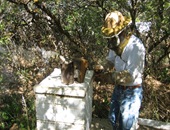
IMG_6807 About a month ago, we (Awesome Wife, Trifecta and I) went to a party. It was at a friend of my wife’s place down near the mouth of Little Cottonwood Canyon. They have a couple of acres, a beautiful yard, a small orchard, some pasture (they board horses), tons of beautiful, interesting shrubs and flowers, and a number of beehives. It was a great party, the kind where everyone- adults, spouses, kids- has a good time.

This Part Feels Like A Tangent But Isn’t

That last point is significant. Nowadays, most parties I go to fall into one of three categories:

1) Grown-up party we get invited to by one of my wife’s friends. My wife has a great time, I have a ”play-date” with the other husbands, who may or not be interesting, have anything in common with me, or be people I’d spend more than 30 seconds talking with in the real world.

2) Grown-up party we get invited to by one of my friends. I have a great time, but the incessant, single-themed talk of biking, skiing, camping and hiking trips quickly grows old for my non-outdoor-head wife.

Twins B-day 3) Kid’s parties. Our kids are constantly attending or hosting birthday parties. The good birthday parties are the “Drive-Bys.” You drive by, drop off your kid, pick him/her/them up 3 hours later. The bad kind are the “Parents-Attend-Too” party, where the adults are supposed to stay and “celebrate” as well, which invariably means making conversation with some of the oddest people (your kids’ friends’ parents) you’re ever likely to come across.

But this party was none of those 3. The hostess is a friend of my wife, but she was also the Twins’ pre-school teacher, and so many of their friends were there. And to round it out, her husband, a bright friendly guy I met for the first time that night, is a beekeeper.
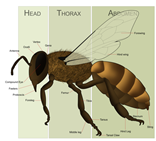
666px-HoneyBeeAnatomy For years I’ve been fascinated by bees. I’ve read probably ½ a dozen bee-related books, and there’s so much about them I find interesting: their communal societies, their venom, their role as pollinators, their bizarre genetic model, and of course, honey. I’ve always wanted to try my hand at beekeeping, but it’s sort of been like hunting for me; I’ve always been curious to try it, but no one in my family ever did it, and I’m not close to anyone who does it regularly today.

The host-husband- let’s call him “Spence”- was eager to talk bees with a fellow enthusiast, and we spent a good part of the evening touring his hives, looking at gear and talking about honey harvests. At the end of the night he invited me to join him to help harvest the honey in a week or so.

One delay led to another- logistics, travel, weather issues- and we missed several tentatively planned harvest dates. Finally yesterday morning I got an email; Spence has Wednesdays off, and was planning to harvest that day. A quick phone call, a moved meeting, and I was back at Spence’s place donning a bee veil and heavy gloves, ready to spend my lunch “hour” as an assistant beekeeper.
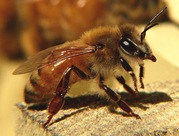
800px-Honeybee-27527-1 We’ve touched on bees a couple of times earlier this year, including Orchard Mason Bees (genus = Osmia) and Bumblebees (genus = Bombus.) Honeybees belong to the genus Apis, which includes 7 species, all native to the Old World. The European Honeybee- the species we’re most familiar with- is Apis mellifera. A. mellifera is further divided into more than 2 dozen subspecies, 2 of which are most popular with North American beekeepers, both for their gentle nature and their productivity: The Italian Honeybee, A. mellifera linguistica, (pic right) and the Carniolan Honeybee, A. mellifera carnica.

Honey Basics

Non-commercial beekeepers, like “Spence”, generally harvest once a year. The idea is that the bees spend all spring and summer collecting nectar which they convert into honey and deposit into wax cells that they build in their hives, and then laying and caring for eggs in those cells. But the bees overproduce to the extent that the beekeeper is able to take the majority of honey from a healthy hive toward the end of the season.
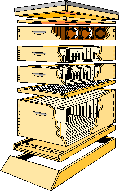
langstroth_coloured People have been stealing- and later harvesting- honey for thousands of years, but the single most important invention in beekeeping was the Langstroth Hive (pictured right, invented by Lorenzo Langstroth) in 1860. The Langstroth Hive consists of a box with a series of removable frames, each of which is filled up with wax and honey over the course of the season. The design allows the beekeeper to easily remove the frames, harvest the honey, and then replace the frames, thereby getting the honey without destroying the hives. There had been earlier frame-style hives, but Langstroth’s breakthrough was to figure out the correct spacing between the frames- 3/8”. Less than that, and the bees can’t move freely between the frames. Greater than 3/8”, and the bees fill the spaces with a cement-like substance called propolis that inhibits removal of the frames.

So, harvesting honey consists of 5 steps:

1- Blow smoke on the bees to calm them down.
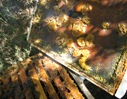
IMG_6812 2- Open the top of the hive and remove the frames, brushing or smoking off cling-on bees.

3- Take the frames someplace away from the hive (like Spence’s garage/barn.)
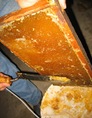
IMG_6816 4- Un-cap the honeycomb cells. Each cell is capped by wax. You uncap them by slicing off the top layer with a heated knife (pic right.)
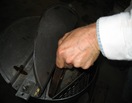
IMG_6818 5- Put the frames- 4 at a time- into a “Spinner”, (pic left) basically a hand-cranked spinning barrel that uses centrifugal force to get the honey out of the (now-uncapped) cells. The honey drains out from a spigot at the bottom of the barrel.

I’m leaving out a lot, but that’s the general idea. Here’s an action video of the most exciting part- removing the frames, in the midst of a swarm of agitated bees.

Tangent: No, I never got stung. I was actually surprised how smoothly the whole deal went. I actually have a whole slew of great bee-sting, and near bee-sting stories, including getting stung on the lower lip while mtn biking on 3 separate occasions, and a near-miss with an angry Africanized swarm a few years back in the Mojave, that I thought about trying to work into a tangent in this post, but I get the feeling this one’s going to be pretty long as it is…

When we finished I headed back to the office, with a cup full of probably the best honey I’ve ever tasted.

So What’s The Deal With Bees Anyway?

The fact that bees can sting, make honey, and have a single queen makes them interesting enough, but the really amazingly weird thing about bees is their genetics.

Way back when, around a billion years ago, after complex living things- or Eukaryotes- had split into plants and animals, but before there were fish or dragonflies or anything like that, animals took 2 different evolutionary structural paths. One group started to evolve an internal support framework- initially cartilage, later bone, and became the Chordates. That group eventually led to sharks, lizards, turtles, birds, moose, cats, dogs and us. bee3The other group started to evolve a support structure on the outside, which later became chitin, and that group eventually led to spiders, lobsters, butterflies, woodlice, shrimp, crickets and bees. We haven’t shared a common ancestor with bees since that split, and yet, over the intervening billion years, our separate evolutionary paths have tackled so many of the same problems- vision, thermoregulation, nervous systems, smell, communication. The solutions we’ve ended up with to these problems are in each case wildly different, but probably the strangest area of difference is in genetics and reproduction.
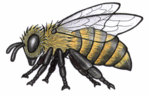
For most of the creatures we’ve talked about in this blog, both animals and plants, the normal genetic baseline has been diploidy. That is, half a set of chromosomes from each parent. That’s how it works for us and moose and turtles and birds, and although plants have made all kinds of innovations, like polyploidy and ring meiosis, it’s the basic model for them as well.
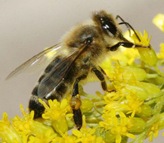
693px-Carnica_bee_on_solidago But bees, as well as wasps and ants- all members of the insect order Hymenoptera- have taken a different genetic path. Over 100 million years ago they forsook full diploidy, and the path they’ve taken since has led them to become one of the most successful groups of animals in the history of life, with tens of thousands of species all over the planet.

Side Note: The original Hymenopterans are thought to have been wasps, which are generally predatory, and often parasitic. At some point, some wasps switched over from a primarily carnivorous to a primarily pollen & nectar-based diet, and these wasps presumably evolved into bees.

Hymenoptera are Haplo-Diploid, meaning that some members of the species- specifically females- are fully diploid, while the males have only half the number of chromosomes as the females. In my family, this would be as though Awesome Wife and Twin B had 46 chromosomes, while I, the Bird Whisperer and Twin A only had 23 chromosomes.
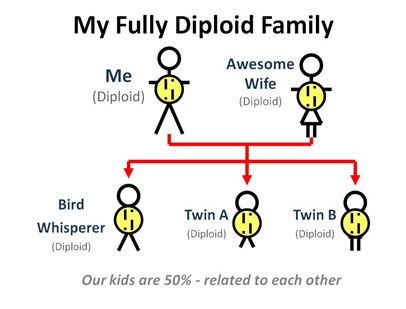
Fully Diploid Family

But the analogy breaks down there, because in Hymenoptera, males have no fathers- each is created from an unfertilized egg. Fertilized eggs always develop into females- either fertile females (queens) or sterile females (workers.)

With bees, the model gets even weirder, because queen bees mate with just one drone (male) during their mating flight.

Adults-Only-Tangent: The reason for this is both simple and grotesque. When bees mate, the male’s genitalia is ripped from his body, and remains lodged in the female’s genital opening. This of course leads to the drone’s death. Another tidbit, so long as we’ve broached the topic of genitalia: Bees can only mate in flight, in mid-air, because wind is required to expose their genitalia.

The queen returns to her hive with a cargo of sperm from her single mating flight, and that sperm will be used to produce fertilized eggs (workers and queens) for the rest of her life.

But it gets even weirder, because each one of those millions of sperm she brought back with her is exactly the same. This makes sense when you think about it: a sperm cell is haploid (half the number of chromosomes.) But a drone has only half the number of chromosomes to begin with, so each one of his millions of sperm produced carries exactly the same (all of his) genes.

So What?

Why does this matter? Here’s why: In a “normal” diploid family like mine, siblings are on average 50%-related. Twin A and Twin B have about ½ of their genes in common (they’re fraternal, not identical.) That’s because they each got a random sampling of ½ of my genes and ½ of Awesome Wife’s genes, so they probably got about half of the same total stuff out of the deal.
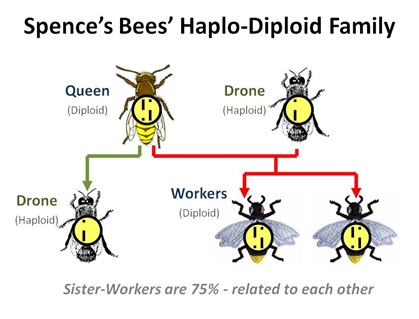
Haplo Diploid Family

But with sister worker-bees, it’s different; they got roughly half the same stuff from their mother, but they got exactly the same stuff from their father (because all his sperm are identical), so on average, they’re 75%-related. Bees, like people are only 50%-related to their parents and their offspring (think about it, it makes sense) so that means that worker bees are more closely related to their sisters than they would be to their own offspring (if they had them.)

Step Back

Making Copies In the big picture, living things exist to do one thing: make copies of their genes. This isn’t because they want to or should do so or are told to; it’s simply because things that makes copies of themselves tend to be more common and persist much more so than things that don’t. In the human world, it’s simple. I have kids, my friend Paul doesn’t. 50 years from now, my tree-geek genes will still be around; his rainbow-spirit-believing-genes won’t. My coworker Tom has 7 kids. 50 years from now there’ll be a lot more of his good-coworker genes around than my tree-geek genes.

But if you’re more closely related to your sisters than you are to your own children, then the most productive thing you can do to propagate your own genes is… help your mother make more daughters. And now, living in a hive and busting your butt to support your queen/mother while forsaking reproduction yourself doesn’t look so pointless. Again, it’s not that bees want to make sisters, but rather that those that do make more sisters become much more common over time than bees that don’t.

Back Home

The honey was a great hit with the family, and a step forward in my ongoing, long-term, low-intensity lobbying campaign to introduce a hive to our yard. Bird Whisperer and Twin B are now firmly in my camp; Twin A and Awesome Wife are still holdouts. But it’s a while till next Spring, and I’ve made a living in sales for 20 years. Time is on my side.